Table of Contents 1. USGS America the Beautiful store, at any national park entrance station, or at Grand Canyon Visitor Center IMAX in Tusayan, just outside the South Rim entrance gates. Picking one up at Grand Canyon Visitor Center IMAX before you reach the park can save meaningful time at the entrance booth during busy periods.
There are also several pass categories worth knowing about:
America the Beautiful Annual Pass: Standard pass for the general public. Valid for 12 months. Covers the pass holder and up to three additional adults in the same vehicle (children under 15 always free).Senior Pass (Lifetime): For US citizens or permanent residents aged 62 and older. A one-time fee for lifetime access.Senior Pass (Annual): A lower-cost annual version of the Senior Pass for those who prefer not to pay the lifetime fee upfront.Access Pass: Free lifetime pass for US citizens or permanent residents with permanent disabilities.Military Annual Pass: Free for current US military personnel and their dependents. Veterans are eligible for a free lifetime pass.Fourth Grade Pass: Free for US fourth graders and their families, valid through the school year. International visitors are eligible to purchase the standard America the Beautiful Annual Pass. The senior, military, access, and fourth grade passes are restricted to US citizens and permanent residents.
How the South Rim Entrance System Works in Practice Many international visitors arrive expecting something resembling a theme park or European heritage site entrance, with queuing lanes and ticketing kiosks at the gate. The Grand Canyon South Rim entrance experience is different. It functions more like a highway toll station, with one or more booths staffed by NPS rangers who collect fees, hand over a park map and newspaper, and send you on your way in under two minutes during off-peak periods.
During peak season, Memorial Day weekend through Labor Day, and again over spring break in March and April, wait times at the entrance gate can stretch to 45 minutes or more. This is where advance preparation pays off. If you already have an America the Beautiful pass, you can use the pass lane (when available) or simply present it at the booth without needing to pay. If you’ve reserved a timed entry permit during a high-demand period (the NPS occasionally implements these for the South Rim during extreme peak dates), having your reservation confirmation ready on your phone speeds things up considerably.
Timed Entry Permits: What International Visitors Need to Know The NPS has piloted timed entry reservation systems at several high-traffic parks and may implement them at the South Rim during specific high-demand windows. When active, these systems require visitors to book a specific entry window in advance through the Recreation.gov platform . Reservations are available to anyone with an account, regardless of nationality, and can be made with any major international credit card.
The best approach is to check the NPS Grand Canyon site in the weeks before your trip to see if timed entry is in effect for your visit dates. If it is, book as early as possible, these slots fill quickly. If timed entry is not in effect, no reservation is needed for standard day visits to the South Rim.
Stop at Grand Canyon Visitor Center IMAX Before You Enter the Park Before driving through the South Rim entrance gates, there’s a stop that can genuinely transform your visit: Grand Canyon Visitor Center IMAX , located in Tusayan just outside the park’s South Entrance. This is not the NPS-operated visitor center inside Grand Canyon Village, it is a privately operated facility that functions as an orientation hub, ticketing resource, and cinematic experience, all in one location.
The centerpiece is the Grand Canyon IMAX Theater , screening “Grand Canyon: Rivers of Time” on a six-story screen using IMAX with Laser technology. The film walks viewers through the geological history, cultural significance, and visual drama of the canyon in a way that no trailhead sign or park brochure can replicate. For international visitors who may have limited background knowledge of the canyon’s formation or Indigenous history, this 34-minute film provides context that makes the real thing far more meaningful when you finally stand at the rim.
Practically speaking, stopping at Grand Canyon Visitor Center IMAX before entering the park gives you access to:
National Park entrance passes sold on-site, so you can skip the fee transaction at the entrance booth entirelyPink Jeep Tours , with the office on-site and tours departing directly from the front door, every Pink Jeep Tour originating here includes a “Rivers of Time” IMAX ticketOn-site dining at Pizza Hut Express and Explorers Café, useful if you’ve driven from Flagstaff or Williams without stoppingA large retail store stocking souvenirs, hiking gear, and supplies you might need inside the parkUltra-Fast 150 kW and Hyper-Fast 350 kW EV charging for road-trip travelers driving electric vehicles You can book IMAX tickets online in advance and save 20% compared to walk-up pricing. For international visitors managing a tight itinerary, this kind of pre-planning removes one more variable from an already complex travel day.
If you’re using the Grand Canyon Tusayan Shuttle , it stops at locations in Tusayan before heading into the park, making Grand Canyon Visitor Center IMAX a natural first stop even without a rental car.
Navigating the Grand Canyon South Rim Visitor Center Inside the Park Once inside the park, the primary orientation stop is the Grand Canyon South Rim Visitor Center , operated by the NPS and located at Grand Canyon Village near Mather Point. This is the official NPS facility, distinct from Grand Canyon Visitor Center IMAX in Tusayan. If you’ve already stopped at the IMAX facility for your film and passes, the NPS visitor center serves a different purpose: it’s where you pick up backcountry permits, speak with rangers, access the official park map in multiple languages, and get current condition updates for trails.
The NPS visitor center also houses the Yavapai Geology Museum nearby, which provides detailed geological displays explaining how the canyon was formed over nearly two billion years of Earth’s history. For visitors with a scientific or educational interest in the canyon’s geology, this stop is worth the time.
What to Expect at the NPS Visitor Center The Grand Canyon South Rim Visitor Center inside the park is open year-round, though hours vary by season. It offers:
Multilingual park maps and orientation materials (available in multiple languages including Spanish, French, German, Japanese, and Mandarin) Ranger-led programs and talks, posted on the daily schedule board at the center Backcountry permit processing (if you plan to camp below the rim) Accessibility information and equipment loans for visitors with mobility needs Current trail condition reports, particularly important if you plan to descend Bright Angel or South Kaibab Trail During peak season, the NPS visitor center can be crowded. If your primary goal is orientation rather than permits, the film at Grand Canyon IMAX Theater in Tusayan covers the visual and historical context more compellingly than any brochure, and allows you to arrive at the rim already informed.
Getting to the South Rim: Route Options for International Visitors The South Rim sits at approximately 7,000 feet above sea level in northern Arizona. For most international visitors flying into the United States, the most common arrival airports are Phoenix Sky Harbor (PHX) and Las Vegas Harry Reid International (LAS), both roughly four to five hours from the South Rim by road.
A smaller but growing number of visitors fly into Flagstaff Pulliam Airport (FLG), which is just 80 miles from the South Rim and offers direct connections from several major US hub cities. Flagstaff is also accessible by Amtrak from Los Angeles and Chicago via the Southwest Chief route, making it a viable option for rail travelers.
Driving from Phoenix The Phoenix route follows I-17 North to Flagstaff, then AZ-180 North through Valle to Tusayan and the South Entrance. The drive takes approximately four to four and a half hours without stops. This route passes through some genuinely dramatic high desert and ponderosa pine forest, and the elevation change from the Phoenix basin (1,100 feet) to the canyon rim (7,000 feet) is noticeable. If you’re traveling from sea level internationally, give yourself time to acclimate, headaches and mild fatigue from altitude are common on the first day.
Driving from Las Vegas The Las Vegas route follows US-93 South to Kingman, then AZ-40 East to Williams, and finally AZ-64 North to Tusayan and the South Entrance. This route takes approximately four and a half to five hours. Las Vegas remains one of the most popular international arrival points for Grand Canyon visitors because of its large international airport and its position as a multi-night base for Southwest road trips.
Guided Tours and Commercial Transportation Many international visitors, particularly those on their first US trip or traveling without a driver’s license valid in the US, arrive at the South Rim via guided tour. Operators run multi-day tours from Phoenix, Las Vegas, and Los Angeles that include Grand Canyon as a primary stop. These tours typically handle entrance fees as part of the package price, so check your booking confirmation to clarify what’s included before purchasing a separate park pass.
The NPS free shuttle system inside the park connects the main viewpoints along the South Rim and is available to all visitors. No reservation is required, and it runs on multiple color-coded routes including the Village Route, Kaibab/Rim Route, and Hermit Rest Route.
What to See: A Practical South Rim Orientation for First-Time International Visitors The Grand Canyon is 277 miles long, up to 18 miles wide, and over a mile deep. The South Rim provides access to perhaps 10% of that total geography, but those 10% include the most iconic and accessible viewpoints on Earth. The challenge for international visitors with limited time is prioritizing intelligently rather than rushing between every overlook.
The Rim Trail The Rim Trail runs roughly 13 miles along the South Rim from Hermit’s Rest in the west to South Kaibab Trailhead in the east. You don’t need to walk the entire trail, most visitors access it in sections, connecting viewpoints via shuttle. The paved, accessible section between Mather Point and Bright Angel Trailhead is the most popular stretch and offers some of the most dramatic canyon views from the rim level.
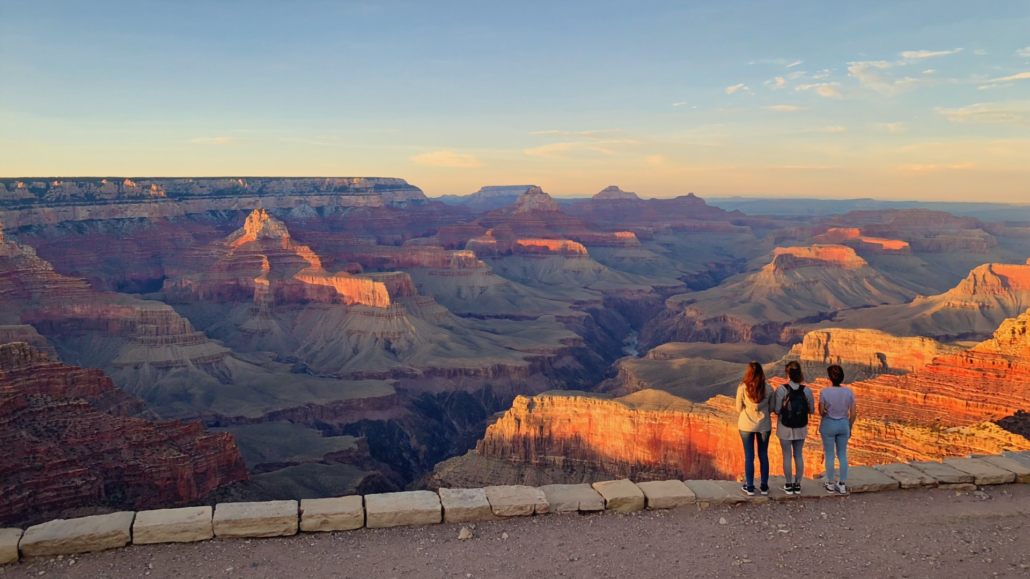
Mather Point Mather Point is typically the first viewpoint international visitors reach, positioned near the main entrance road. It offers a panoramic view of the central canyon and is the site where most visitors experience their first emotional response to the scale of what they’re seeing. The view here is legitimately world-stopping, and no photograph adequately prepares you for the depth and layering of color in the rock walls.
Desert View Watchtower Located at the eastern end of the South Rim, Desert View Watchtower is a 70-foot stone tower designed by architect Mary Colter and completed in 1932. It offers views into the eastern canyon and on clear days provides a glimpse of the Colorado River below. The drive to Desert View from Grand Canyon Village is approximately 25 miles and passes several quieter overlooks that see fewer visitors than the main viewpoints.
Sunrise and Sunset Viewing Watching light change across the canyon at sunrise or sunset is one of the defining experiences of a South Rim visit. Mather Point and Yaki Point are popular sunrise spots; Hopi Point and Mohave Point on the Hermit Road are favored for sunsets. Hermit Road is closed to private vehicles in the morning and afternoon hours during peak season (shuttle service runs the route), so plan accordingly. For a broader look at the canyon’s dramatic lighting patterns, the visual conditions at the South Rim can be genuinely spectacular even on overcast days when cloud shadows move across the canyon walls.
Trail Safety and Practical Hiking Advice for International Visitors The Grand Canyon inverts the hiking experience that most international visitors are familiar with. You begin at the top and descend into the canyon, which means the hardest part, the uphill climb back to the rim, comes at the end of the day when you’re already tired, dehydrated, and often facing afternoon heat. The NPS actively warns against attempting to hike from the rim to the river and back in a single day. Many of the visitors who require emergency rescues each year made exactly that attempt.
For international visitors who are fit and experienced hikers, a descent of one to three miles on Bright Angel Trail or South Kaibab Trail is entirely manageable. Going beyond that without an overnight permit requires careful planning, adequate water (at least one liter per hour in warm weather), salty snacks to maintain electrolytes, and a realistic turnaround plan.
Altitude and Acclimatization At 7,000 feet, the South Rim sits at an elevation higher than most major international cities. Visitors arriving from near sea level, which includes most of coastal Europe, Asia, and Australia, may feel mild altitude effects in the first 24 hours. Symptoms typically include headache, mild fatigue, and slight shortness of breath during exertion. Staying well-hydrated, avoiding alcohol on arrival day, and taking the first hours slowly are the most effective countermeasures.
Water Potable water is available at several locations along the South Rim, including refilling stations near the main trailheads. Carrying a reusable water bottle and filling it before descending any trail is strongly recommended. In summer months, the temperature at the inner canyon floor can exceed 110°F (43°C), and dehydration develops faster than most visitors expect.
Seasonal Conditions: When to Visit and What to Expect The South Rim operates year-round, which sets it apart from the North Rim (typically open May through mid-November). Each season offers a genuinely different experience, and understanding the tradeoffs helps international visitors choose the right travel window.
Season Conditions Crowds Best For Spring (Mar–May) Mild to warm rim, cool inner canyon. Snow possible in March. ⚠️ High (spring break peaks) Hiking, photography, wildflowers Summer (Jun–Aug) Hot at the rim (80–90°F), extreme heat in the canyon. Monsoon storms in July–August. ❌ Peak crowds Rim views, early morning activity, family visits Fall (Sep–Nov) Cooling temperatures, excellent visibility. One of the best hiking windows. ✅ Moderate, decreasing Hiking, photography, uncrowded viewpoints Winter (Dec–Feb) Cold at the rim (20–40°F), possible snow. Canyon walls dusted in white. ✅ Low crowds Solitude, dramatic winter light, budget travel
For international visitors with flexibility, fall, particularly September and October, offers the best combination of manageable crowds, excellent hiking conditions, and reliable visibility. Winter visits are genuinely underrated; a snow-dusted canyon rim with few other visitors present is one of the more unusual and memorable natural experiences available in the American Southwest.
Guided Tour Options: Pink Jeep Tours and What to Expect For international visitors who want a structured, interpreted experience rather than self-guided exploration, guided tours offer significant advantages. A knowledgeable guide provides geological context, points out features you’d otherwise miss, and manages the logistics of moving between viewpoints efficiently.
Pink Jeep Tours, recognized as Best Tour Operator, operates its Grand Canyon office on-site at Grand Canyon Visitor Center IMAX in Tusayan. Tours depart directly from the front door, which means you can combine your IMAX film experience with a guided jeep tour in a single stop before or after entering the park. Every Pink Jeep Tour originating from Grand Canyon Visitor Center IMAX includes a ticket to “Grand Canyon: Rivers of Time,” making the combination one of the most complete orientation packages available at the South Rim.
Guided jeep tours are particularly valuable for international visitors because:
The guide handles all navigation and park logistics, eliminating the need to interpret shuttle maps and trail signs in a second language Tours access viewpoints and perspectives not easily reached on foot from the main rim trail The group format provides built-in social connection, which many solo international travelers find valuable Guides provide cultural and geological context that transforms a scenic drive into an educational experience Book Pink Jeep Tours in advance, particularly if visiting during peak season. The combination of limited vehicle capacity and high demand means last-minute bookings are often unavailable, especially for morning departure slots.
Practical Logistics: Currency, Connectivity, and Communication The Grand Canyon area is more connected than it used to be, but international visitors should set realistic expectations about cell service and digital access inside the park.
Cell Service and Wi-Fi Cell coverage inside Grand Canyon National Park is limited and unreliable. Most major US carriers have some signal at Grand Canyon Village and near the main visitor center, but coverage drops off along the rim trail and disappears entirely below the rim. Download offline maps (Google Maps and Maps.me both support this), save the park map PDF from the NPS website before you arrive, and don’t rely on real-time navigation inside the park.
Wi-Fi is available at Grand Canyon Visitor Center IMAX in Tusayan, at the Bright Angel Lodge, and at a small number of in-park lodging properties. It is not available on the trails.
International SIM Cards and Roaming If you’re using an international SIM card or relying on roaming from your home carrier, check coverage maps in advance. The Tusayan area and Grand Canyon Village have reasonable signal, but coverage in the canyon itself is essentially nonexistent. Many international visitors purchase a prepaid US SIM card in Phoenix or Las Vegas before arriving, this is a practical option if you’re spending more than a few days in the American Southwest.
Currency and Payment US dollars are the only currency accepted at the park entrance, in park facilities, and at Grand Canyon Visitor Center IMAX. Most locations accept major credit cards (Visa, Mastercard, American Express, Discover). Some smaller concession stands inside the park are cash-only or have limited card terminals, so carrying some US cash is advisable. ATMs are available in Grand Canyon Village, but fees for international card users can be significant.
Language and Accessibility English is the primary language of operation throughout the park. The NPS produces park maps and basic orientation materials in several languages; ask at the visitor center or entrance gate. Ranger-led programs are conducted in English only. For non-English speakers, the visual experience of “Grand Canyon: Rivers of Time” at Grand Canyon IMAX Theater conveys the canyon’s story through cinematography and narration in a way that transcends language barriers, the imagery alone communicates the scale and drama of the landscape.
The International Visitor’s Decision Framework: Planning Your Entry Given the range of options, here’s a practical decision framework for international visitors to use when planning their South Rim entry:
Your Situation Recommended Action Where to Act Visiting Grand Canyon only (single park) Pay standard vehicle/per-person entry fee at the gate or buy at Grand Canyon Visitor Center IMAX in Tusayan Grand Canyon Visitor Center IMAX or entrance gate Visiting 2+ national parks on same trip Purchase America the Beautiful Annual Pass, saves money immediately Grand Canyon Visitor Center IMAX, online via USGS store, or entrance gate Arriving during peak season (Jun–Aug) Check for timed entry reservations, buy pass in advance, stop at Tusayan before the gate to save time Recreation.gov (reservations), Grand Canyon Visitor Center IMAX (passes) No rental car / arriving by commercial transport Per-person entry fee applies; consider booking a guided tour that includes entry Pink Jeep Tours at Grand Canyon Visitor Center IMAX Planning to hike below the rim overnight Obtain backcountry permit in advance through NPS lottery; entry fee still required separately NPS Backcountry Information Center (permit), entrance gate (entry fee) Driving an electric vehicle Charge at Grand Canyon Visitor Center IMAX before entering (150 kW and 350 kW available); limited EV infrastructure inside the park Grand Canyon Visitor Center IMAX, Tusayan
What the Grand Canyon’s Wildlife and Geology Mean for Your Visit Understanding a little of what you’re looking at transforms the Grand Canyon from an overwhelming landscape into a readable one. The canyon walls expose nearly two billion years of Earth’s geological history in layers visible from the rim. The oldest rocks at the bottom of the canyon, the Vishnu Basement Rocks, are approximately 1.8 billion years old. The youngest rim rocks, the Kaibab Limestone you’re standing on at the South Rim, are roughly 270 million years old. The gap between those numbers represents an unconformity where a billion years of geological record is simply missing, a fact that has fascinated geologists since it was first described.
Wildlife at the South Rim includes California condors, which were brought back from the edge of extinction and now soar above the canyon rim on thermal currents. Spotting a condor with its distinctive 9.5-foot wingspan is one of the more memorable wildlife encounters available in North America. Mule deer are common at Grand Canyon Village and along the rim trail, particularly in early morning and evening hours. For more detailed wildlife watching guidance, the Grand Canyon wildlife tips available at explorethecanyon.com offer practical advice on where and when to look for the park’s most iconic species.
Remind yourself (and any children in your group) that feeding wildlife is prohibited throughout the national park. This is enforced, and the reasoning is straightforward: human food disrupts animal behavior, creates dependency, and ultimately harms the animals it appears to help.
Frequently Asked Questions from International Visitors Do I need a US visa to visit Grand Canyon National Park? Entry to Grand Canyon National Park requires standard US entry authorization. Visitors from Visa Waiver Program countries must obtain ESTA authorization before traveling; visitors from other countries need a valid US tourist visa (B-2). The park itself has no separate entry authorization requirement beyond standard US immigration rules.
Is the Grand Canyon entrance fee the same for everyone regardless of nationality? Yes. The Grand Canyon park fees are uniform across all nationalities. There is no international visitor surcharge. Children under 15 enter free regardless of nationality.
Can I buy a National Park pass as an international visitor? Yes. The America the Beautiful Annual Pass is available for purchase by anyone, regardless of nationality. It can be purchased online, at the entrance gate, or at Grand Canyon Visitor Center IMAX in Tusayan before you reach the park gates. Senior, military, and access passes are restricted to US citizens and permanent residents.
What is Grand Canyon Visitor Center IMAX and why should I stop there? Grand Canyon Visitor Center IMAX is a privately operated facility located in Tusayan, just outside the South Rim entrance gates. It is not affiliated with the NPS. It screens “Grand Canyon: Rivers of Time” on a six-story IMAX with Laser screen, sells National Park entrance passes, hosts Pink Jeep Tours, offers dining and retail, and provides Ultra-Fast EV charging. Stopping there before entering the park saves time at the entrance gate and provides excellent orientation context for your visit.
How long does it take to drive from Phoenix to the Grand Canyon South Rim? Approximately four to four and a half hours without stops, traveling via I-17 North to Flagstaff and then AZ-180 North through Valle to Tusayan. Allow additional time for stops, fuel, and traffic around Flagstaff.
Is the Grand Canyon open year-round? The South Rim is open year-round, 24 hours a day. Some facilities within the park close or reduce hours in winter. The North Rim operates seasonally and is typically closed from mid-November through mid-May.
What languages are available at the park? The NPS produces park maps and orientation materials in several languages. Ranger programs operate in English only. The IMAX film “Grand Canyon: Rivers of Time” at Grand Canyon Visitor Center IMAX is primarily narrated in English but communicates the canyon’s story powerfully through its visual imagery.
Can I hike into the canyon on a day visit? Yes, with proper preparation. Short day hikes of one to three miles on Bright Angel Trail or South Kaibab Trail are accessible to reasonably fit visitors. The NPS explicitly advises against attempting to reach the Colorado River and return in a single day. Always carry more water than you think you need, wear sun protection, and turn around before you feel tired.
Do I need a permit to hike in the Grand Canyon? Day hikes from the rim do not require a permit. Overnight camping below the rim requires a backcountry permit, obtained through the NPS Backcountry Information Center. Permits are allocated by lottery for popular months and must be applied for well in advance.
Is cell service available inside the park? Cell service inside Grand Canyon National Park is limited and unreliable. Download offline maps before arriving. Wi-Fi is available at select lodging properties and at Grand Canyon Visitor Center IMAX in Tusayan.
What should I wear and pack for a day visit to the South Rim? Layering is essential, rim temperatures can change significantly throughout the day, particularly in spring and fall. Sun protection (hat, sunscreen, UV-protective clothing) is critical year-round at this elevation. Sturdy footwear is important if you plan to walk any section of the rim trail or descend any trail. A reusable water bottle, snacks, and a light jacket cover most scenarios for a rim-level day visit.
How early should I arrive at the South Rim to avoid crowds? Arriving before 8:00 AM gives you the best chance of finding uncrowded viewpoints and available parking during peak season. The rim at sunrise is genuinely magical and sees a fraction of the midday crowds. The entrance gate at the South Rim also processes vehicles faster in the early morning hours.
Key Takeaways for International Grand Canyon Visitors Entry fees apply to everyone regardless of nationality, but children under 15 always enter free. The fee covers seven consecutive days of access.The America the Beautiful Annual Pass is available to international visitors and pays for itself if you’re visiting two or more national parks on the same trip.Stop at Grand Canyon Visitor Center IMAX in Tusayan before entering the park. You can purchase park passes, watch the orientation film, book Pink Jeep Tours, charge your EV, and grab a meal, all before reaching the entrance gate. Book IMAX tickets online to save 20%.Grand Canyon Visitor Center IMAX is not the NPS visitor center. It’s a separate, privately operated facility in Tusayan, outside the park gates. The official NPS visitor center is inside the park at Grand Canyon Village.Check for timed entry reservations on Recreation.gov if visiting during peak season. These fill quickly when implemented.Download offline maps before arriving, cell coverage inside the park is limited and unreliable.Altitude matters. At 7,000 feet, the South Rim sits significantly higher than most international travelers’ home cities. Hydrate well and pace yourself on arrival day.Fall is the best-kept seasonal secret at the South Rim. Moderate temperatures, thinner crowds, and exceptional visibility make September and October genuinely excellent months to visit.Guided tours depart from Grand Canyon Visitor Center IMAX. Every Pink Jeep Tour originating from this location includes a “Rivers of Time” IMAX ticket, making it the most complete single-stop orientation experience at the South Rim.The canyon rewards context. Watching “Grand Canyon: Rivers of Time” before standing at the rim gives you the geological and cultural framework to understand what you’re seeing. The experience at the rim is genuinely different, and deeper, when you arrive already informed.