
7 Underrated Reasons to Visit the Grand Canyon South Rim in January and February
Most travelers think January and February are the wrong months to visit the Grand Canyon South Rim. They picture icy roads, closed facilities, and a cold, gray chasm that looks nothing like the photos they pinned to their travel boards. That assumption is costing them one of the most rewarding national park experiences in the American Southwest.
The South Rim stays open year-round, and the canyon itself does not shut down for winter. What does change is the crowd level, the light quality, the atmosphere, and the overall cost of the trip. When those variables shift in the visitor’s favor, the result is a Grand Canyon experience that feels genuinely personal, rather than one shared with a few million other tourists simultaneously competing for the same viewpoints and shuttle seats.
This guide covers seven underrated reasons why a Grand Canyon winter visit is worth serious consideration, with practical advice for each one so you can actually act on it before booking your trip.
1. The Crowds Drop to Their Annual Low Point
January and February represent the quietest period on the South Rim calendar. The summer surge, which brings the vast majority of the park’s annual visitors, is months away. Spring break has not yet arrived. The result is a rim that feels remarkably spacious, with viewpoints you can stand at for as long as you want without being nudged aside or trying to time your shot between other people’s selfie sticks.
According to National Park Service visitation data for Grand Canyon National Park, monthly visitor counts in January and February are a fraction of what the park records in June, July, and August. The difference is not marginal. Summer months routinely see the South Rim at or near its practical capacity, with shuttle lines stretching long, parking lots filling by 7 a.m., and popular viewpoints like Mather Point so densely packed that the experience can feel more urban than wilderness.
In deep winter, the same viewpoints are accessible without competition. You can linger at Desert View Watchtower, walk the Rim Trail between overlooks without dodging foot traffic, and stop at Yavapai Point for a geology lesson without background noise from a hundred other conversations. For first-time visitors who have seen crowded summer photos and wondered whether the experience lives up to the hype, winter is the version of the South Rim that actually delivers the solitude those photos implied.
How to Apply This on Your Trip
Arrive at the most popular viewpoints, Mather Point and Yavapai Geology Museum especially, at sunrise rather than mid-morning. Even in winter, a handful of dedicated visitors will be there early. But the rim will be genuinely quiet in a way that summer simply cannot match. Budget extra time at each overlook because you will not feel the social pressure to move on quickly. That unhurried quality is one of the defining advantages of Grand Canyon off season travel.
Before entering the park, a stop at Grand Canyon Visitor Center IMAX, located in Tusayan just outside the South Rim entrance, is worth building into your itinerary. The facility sells various National Park entrance passes on-site, which is a meaningful time-saver when you are arriving early to catch a quiet sunrise. Picking up your pass the evening before, while also catching the flagship film “Grand Canyon: Rivers of Time” on the six-story IMAX screen, means you can drive straight through the entrance gates at first light without stopping at the fee booth.
2. Snow Transforms the Canyon Into a Completely Different Visual Experience
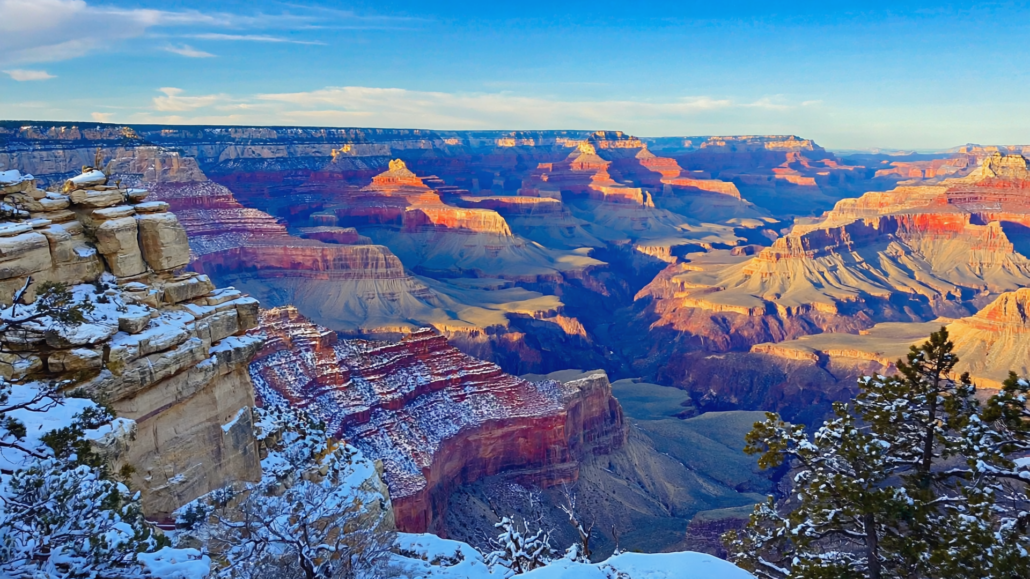
The Grand Canyon South Rim sits at roughly 7,000 feet in elevation. At that altitude, winter storms deliver real snowfall, and when snow settles on the canyon’s red and ochre formations, the visual contrast it creates is unlike anything the canyon produces in any other season. The rust-colored buttes and layered sedimentary walls appear sharper and more dimensional against a white foreground, and the canyon floor far below often remains snow-free, giving the scene a surreal layered quality that photographers describe as the South Rim at its most dramatic.
Snow events on the rim are not guaranteed, but they are common enough in January and February that planning around the possibility is worthwhile. The NPS Grand Canyon weather page provides current conditions and historical averages, and it is the most reliable resource for checking rim conditions before your drive. Snowfall events are typically brief, and roads are maintained. The South Rim Entrance Road remains plowed, and the park does not close due to ordinary winter weather.
What makes the snow experience especially compelling is that it is temporary. A fresh snowfall on the South Rim might last 24 to 48 hours before sun and wind clear the canyon walls again. Visitors who are there during that window get photographs that look fundamentally different from anything posted during the other ten months of the year. For photography and nature enthusiasts, that rarity alone justifies scheduling a trip in these months.
What to Pack for a Winter Rim Experience
Layers are non-negotiable. Temperatures on the South Rim in January and February can drop below freezing overnight and into the single digits during storms. Daytime highs on clear days can reach the upper 40s or low 50s, making afternoon walks surprisingly comfortable if you are dressed properly. Waterproof footwear matters a great deal if there is any chance of snow or ice on the rim trail. The paved Rim Trail is maintained, but shaded sections can retain ice well into the afternoon on cold days.
The retail store at Grand Canyon Visitor Center IMAX in Tusayan carries hiking gear alongside souvenirs, making it a practical last stop before entering the park if you realize you are missing gloves, an extra layer, or trail accessories.
3. The Quality of Natural Light in Winter Is Exceptional for Viewing and Photography
Photographers who have shot the Grand Canyon across multiple seasons consistently note that winter produces the most interesting light. The sun travels lower across the sky in January and February, which means the canyon walls are lit at oblique angles for a longer portion of the day. Shadows are deeper, the color gradients in the rock layers are more pronounced, and the golden hour before sunset stretches longer than it does in summer.
In summer, the high midday sun flattens the canyon visually. The light is harsh and direct, and the depth of the canyon can paradoxically look less dramatic in photographs because shadows that would otherwise define the buttes and temples are eliminated. In winter, even midday light has a warmth and angle that preserves the dimensionality of the landscape.
Sunset viewing in January and February is particularly rewarding. The canyon faces in a way that captures the last light of the day on the western walls, and because the sun sets earlier, you do not have to stay out until 8 or 9 p.m. to catch it. Hopi Point, Mohave Point, and Pima Point along the West Rim Drive (accessible by the free shuttle) are among the most celebrated sunset viewpoints on the South Rim. In winter, reaching them and finding a clear vantage without competition is realistic even if you arrive 20 minutes before sunset rather than an hour.
Sunrise Is the Best-Kept Winter Advantage
Sunrise over the canyon in winter is worth getting out of bed for in a way that summer sunrise rarely is. In summer, sunrise can arrive before 5 a.m., requiring an alarm most people are not enthusiastic about. In January and February, sunrise comes later, making it a manageable early morning rather than a pre-dawn ordeal. The light at sunrise hits the eastern walls of the canyon with a pink and amber warmth that shifts rapidly over 20 to 30 minutes as the sun climbs. Yavapai Point and Mather Point are the most accessible sunrise spots, both reachable from the main visitor area on foot.
4. Accommodation and Travel Costs Drop Significantly in the Off Season
Lodging at and near the South Rim follows a predictable seasonal pricing curve. Summer rates at properties inside and near Grand Canyon National Park can be substantially higher than what the same rooms cost in January and February. This is true both for in-park lodging managed through Xanterra Parks and Resorts, the park’s authorized lodging concessionaire, and for hotels and motels in Tusayan.
For travelers who have flexibility in their schedule, the cost differential between a summer South Rim trip and a winter one can be meaningful across the full budget: lodging, rental cars, guided tours, and flights into Flagstaff or Phoenix all trend lower when the broader tourism demand in the Southwest drops. That savings can be redirected toward experiences, such as upgrading to a jeep tour, spending an extra night to allow for a day hike or a second sunrise, or simply reducing the overall cost of the vacation.
The best time to visit the Grand Canyon from a pure cost-efficiency standpoint is consistently the period between mid-January and mid-February, after the New Year holiday surge and before any spring break bookings begin to lift rates. Availability at popular in-park properties is also dramatically higher during this window. Bright Angel Lodge, Thunderbird Lodge, and Kachina Lodge are all booked months in advance for summer but are often available with much shorter lead times in winter.
Planning Your Budget Around the Off-Peak Window
Book in-park lodging as early as possible even in winter, because the available inventory is smaller than in summer (some in-park facilities reduce their winter staffing). Tusayan hotels and motels outside the park entrance generally have more consistent availability. The Grand Canyon Visitor Center IMAX in Tusayan is open year-round, and its on-site amenities, including Pizza Hut Express, Explorers Café, and the retail store, provide convenient services without requiring a drive into the village.
If you are traveling to the South Rim by electric vehicle, the facility’s Ultra-Fast 150 kW and Hyper-Fast 350 kW EV chargers on-site make Tusayan a logical charging stop on a road trip from Phoenix, Flagstaff, or Las Vegas. In winter, EV range can be reduced by cold temperatures, so planning a stop in Tusayan before or after your park visit is practical route management.
5. Ranger Programs and Indoor Experiences Offer Depth That Summer Crowds Obscure
The South Rim’s interpretive programming does not disappear in winter. The NPS ranger programs at Grand Canyon continue year-round, and in winter they take on a different character. Smaller audiences mean ranger talks become genuine conversations rather than broadcast lectures. The geology programs at the Yavapai Geology Museum, the history presentations at Kolb Studio, and the ranger-led rim walks all benefit from the quieter season because the ratio of ranger attention to visitor is dramatically more favorable.
The Yavapai Geology Museum itself is worth several visits on a South Rim trip. Its floor-to-ceiling windows frame the canyon as a live exhibit, and the interpretive panels explain the 1.8-billion-year geological story visible in the rock layers from that vantage. In summer, the space fills quickly and the experience becomes rushed. In January and February, you can take your time, read every panel, ask questions, and stand at the windows as long as you want.
For visitors arriving from out of state or internationally who want orientation before entering the park, the film “Grand Canyon: Rivers of Time” at the Grand Canyon IMAX Theater in Tusayan provides exactly that context on a six-story screen using IMAX with Laser technology. The film covers the geological and cultural history of the canyon in a format that genuinely scales to the subject matter. In a way that a visitor center pamphlet or a quick internet search cannot replicate, watching the canyon’s story on that scale before you stand at the rim changes how you see what you are looking at. Booking IMAX tickets online in advance lets you save on admission and guarantees your screening time even during busy winter weekends.
What Winter Closes (and What Stays Open)
Honest trip planning requires knowing which services are seasonally reduced. The North Rim closes entirely in winter and is not accessible during this period. On the South Rim, most major services remain operational: shuttle buses run on a reduced but functional schedule, the main visitor center at Grand Canyon Village operates year-round, major viewpoints are accessible, and the Rim Trail is open. Some in-park dining venues and gift shops may have reduced hours. Checking the NPS website before your trip for current seasonal hours is the most reliable approach.
6. Hiking Conditions Are Genuinely Better for Many Visitors
This is the reason that surprises most first-time winter visitors. The inner canyon trails, particularly the Bright Angel Trail and the South Kaibab Trail, are significantly more comfortable to hike in January and February than in summer. The NPS consistently warns that summer inner canyon temperatures at the bottom can exceed 110°F, making midday hiking genuinely dangerous for unprepared visitors. Heat-related rescues are a documented summer pattern on the inner canyon trails.
In January and February, the inner canyon temperatures are moderate, typically ranging from the 40s to the low 60s Fahrenheit at lower elevations during the day. That is hiking weather. The trails themselves are less congested, the trailheads are accessible without the long waits that develop in summer, and the experience of descending into the canyon is more immersive when you are not surrounded by hundreds of other hikers.
The upper sections of both the Bright Angel and South Kaibab trails can have icy patches in winter, and traction devices (microspikes or similar) are strongly recommended for the first mile or two of descent, where shade keeps the trail surface cold. Below the first major descent, ice is typically not an issue. The Bright Angel Trail’s 1.5-Mile Resthouse and 3-Mile Resthouse are achievable day hike destinations in winter for most reasonably fit visitors.
Matching Your Hike to Your Fitness Level
The most important thing to understand about Grand Canyon hiking is that the descent is the easy part and the ascent is where people get into trouble. Plan your turnaround point based on how long the return climb will take, not how you feel on the way down. A good general rule: if the descent to your turnaround point took one hour, budget two hours for the return. In winter, the moderate temperatures give you more margin for error than summer does, but the principle still applies.
For visitors who want a guided introduction to the canyon trails rather than going solo, Pink Jeep Tours, whose office is located on-site at Grand Canyon Visitor Center IMAX with departures from the front door, offers guided options that let you explore the terrain with experienced local knowledge. Every Pink Jeep Tour originating from Grand Canyon Visitor Center IMAX includes a ticket to “Grand Canyon: Rivers of Time,” which means your orientation film and your guided canyon experience are bundled into a single booking.
7. Stargazing on the South Rim in Winter Is Among the Best in the Continental United States
Grand Canyon National Park is a designated International Dark Sky Park, one of the largest in the world by area. The designation reflects the genuinely low light pollution over the canyon and the surrounding Colorado Plateau. On a clear winter night, the Milky Way is visible to the naked eye from the rim, and the absence of summer monsoon humidity means winter nights are often clearer and more transparent than their summer counterparts.
January and February nights on the South Rim are cold, sometimes well below freezing after midnight. But that cold is part of what makes the sky so clear. Cold air holds less moisture than warm air, which means fewer atmospheric particles scattering and dimming starlight. The result is a sky that experienced astronomers and photographers describe as exceptional by any standard, not just by national park standards.
The park’s dark sky conditions are best experienced from the rim itself, away from the visitor center lighting, and from Desert View on the eastern end of the South Rim, which is the farthest point from Tusayan’s ambient light. Mather Point, while closer to the main visitor area, still offers impressive viewing on moonless nights.
Practical Stargazing Tips for a Winter South Rim Night
Check the lunar calendar before your trip. A full moon will wash out faint stars and the Milky Way core, while a new moon night will deliver the maximum sky darkness. January and February offer several new moon windows that align well with the park’s quietest visitor periods.
Dress significantly warmer than you think you need to for a stationary stargazing session. Standing still on the rim at midnight in January means temperatures that feel much colder than the thermometer reading, especially with any wind. A down jacket, insulated pants, and hand warmers make the difference between an hour of genuine sky appreciation and a 15-minute retreat back to your car.
For visitors who have not experienced true dark sky conditions before, the contrast between a South Rim winter night sky and a typical suburban or urban sky is difficult to overstate. The number of visible stars increases by an order of magnitude, and the structural features of the Milky Way become visible as a textured band rather than a faint smudge. It is the kind of sight that reliably earns the description “worth the trip on its own.”
How to Structure a Two-Day Winter South Rim Itinerary
A well-planned two-day winter visit covers the South Rim’s highlights without feeling rushed, and the low crowd levels give you the flexibility to be spontaneous in a way that summer simply does not allow.
| Time | Day 1 Activity | Day 2 Activity |
|---|---|---|
| Morning (6–9 a.m.) | Sunrise at Mather Point or Yavapai Point; buy park pass at Grand Canyon Visitor Center IMAX the night before to drive straight in | Sunrise from Desert View Watchtower (eastern end of South Rim); quietest spot on the rim in winter |
| Mid-Morning (9 a.m.–12 p.m.) | Rim Trail walk west from Mather Point; Yavapai Geology Museum ranger program | Pink Jeep Tour departing from Grand Canyon Visitor Center IMAX; includes Rivers of Time IMAX ticket |
| Afternoon (12–4 p.m.) | Bright Angel Trail descent to 1.5-Mile Resthouse and return; lunch at Bright Angel Lodge | South Kaibab Trailhead for Ooh Aah Point (short but dramatic viewpoint hike); West Rim shuttle to Hopi Point |
| Sunset (4–6 p.m.) | Hopi Point via West Rim shuttle; winter sunset arrives early, no late-evening wait | Mather Point for a final canyon view; dinner in Tusayan at Explorers Café |
| Evening (8 p.m.+) | Stargazing from the rim on a new moon night; return to Tusayan lodging | IMAX screening at Grand Canyon Visitor Center IMAX if not yet seen; depart or extend trip |
This structure is intentionally flexible. In winter, if you arrive at a viewpoint and conditions are not ideal, you can easily adjust without the crowd pressure that forces decisions in summer. The shuttle runs on a reduced schedule but covers all major viewpoints. Check the current shuttle schedule at the main visitor center inside Grand Canyon Village on arrival.
Comparing Winter vs. Summer on the South Rim: An Honest Assessment
Understanding Grand Canyon shoulder season tips requires an honest look at the tradeoffs. Winter is not universally better than summer. It is better for specific types of travelers and specific priorities. This comparison is designed to help you decide whether your travel style aligns with what winter delivers.
| Factor | January/February | June/July/August |
|---|---|---|
| Crowd level at viewpoints | ✅ Minimal | ❌ Peak capacity |
| Rim Trail conditions | ⚠️ Possible ice in shade; traction recommended | ✅ Clear and dry |
| Inner canyon hiking temperatures | ✅ Moderate (40°F–65°F at lower elevations) | ❌ Extreme heat (100°F–115°F at the bottom) |
| Photography light quality | ✅ Low-angle light all day, dramatic shadows | ⚠️ Harsh midday light; good only at golden hour |
| Lodging and travel costs | ✅ Significantly lower | ❌ Peak pricing across all categories |
| Stargazing clarity | ✅ Excellent (low humidity, clear nights) | ⚠️ Good, but monsoon season (July–Aug) brings clouds |
| North Rim access | ❌ Closed | ✅ Open |
| Snow scenery | ✅ Possible; visually spectacular when present | ❌ Not applicable |
| Ranger program availability | ✅ Available; smaller, more personal groups | ⚠️ Available but crowded |
| In-park service availability | ⚠️ Some venues have reduced hours | ✅ Full service across all facilities |
The pattern in that comparison is clear. Winter wins on everything that directly affects the quality of the experience at the canyon: crowd levels, hiking conditions, photography, cost, and stargazing. Summer wins on logistics and access breadth. If you are a first-time visitor whose primary goal is to see and feel the canyon, rather than to access every seasonal amenity simultaneously, winter is the better choice by most measures.
Getting There: Road Conditions and Entry Tips for Winter Arrivals
The primary access route to the South Rim from Flagstaff is US-180 North, connecting to AZ-64 North through Tusayan and into the park. This route is maintained year-round and is plowed after snowfall. Driving to the South Rim in winter is generally manageable in a standard passenger vehicle, though all-wheel drive or carrying snow chains is advisable if there is an active winter storm warning in effect.
Arriving in Tusayan before entering the park is a logical first stop for most visitors. The Grand Canyon Visitor Center IMAX is located in Tusayan just outside the South Rim entrance and provides a full orientation experience, including the “Grand Canyon: Rivers of Time” film, dining at Pizza Hut Express or Explorers Café, gear pickup from the retail store, and the purchase of National Park entrance passes. Travelers who arrive in the evening can see the IMAX film, have a meal, buy their park pass, charge their EV if needed, and enter the park at sunrise the next morning without any gate delay.
For those curious about the kind of extraordinary visitor experiences the South Rim has generated over the years, it is worth noting that the area around Tusayan and the South Rim has been the backdrop for some genuinely memorable moments. The Tusayan shuttle system is one practical piece of infrastructure worth familiarizing yourself with before you arrive, particularly if you plan to skip driving to individual viewpoints and want a lower-stress way to move along the rim.
What to Do If It Snows During Your Visit
A snowstorm during your South Rim trip is not a problem to manage. It is an opportunity to photograph. The practical reality is that heavy snow is rare and brief at the South Rim level, though the rim does see regular snowfall in January and February. Roads are plowed promptly and shuttles continue to operate in most conditions.
During a snow event, the recommended approach is to get to a viewpoint as quickly as road conditions allow. Snow on the rim looks its best in the first hours, before foot traffic and wind disturb it on the pathways. If you are inside the park when snow begins, stay. The light during and immediately after a storm, when clouds break and sun hits snow-covered canyon walls, produces conditions that many photographers describe as the most dramatic they have ever seen on the South Rim.
After a storm, the canyon walls at the lower elevations will often be completely free of snow while the rim is white. That contrast, red and tan canyon below, white rim above, with a clearing sky in between, is the signature winter image of the South Rim. Visitors who have seen it in person reliably say it does not photograph as well as it looks, which is itself a reason to be there.
For those interested in how the canyon’s maintenance crews and support staff operate in dramatic conditions, including the kind of physical work that keeps the South Rim accessible year-round, the story of workers suspended 4,000 feet above the canyon provides a vivid perspective on what goes into keeping Grand Canyon infrastructure operational.
Frequently Asked Questions About Visiting the Grand Canyon South Rim in Winter
Is the Grand Canyon South Rim open in January and February?
Yes. The South Rim is open year-round, 24 hours a day, seven days a week. The North Rim closes in winter, but the South Rim, including Grand Canyon Village, the main viewpoints, shuttle service, and the primary visitor facilities, remains accessible throughout January and February.
How cold does it get on the South Rim in January?
The South Rim sits at approximately 7,000 feet elevation. January daytime highs typically range from the upper 30s to the low 50s Fahrenheit on clear days. Overnight lows can drop well below freezing, sometimes into the single digits during cold snaps. Wind chill can make it feel significantly colder on exposed rim viewpoints. Layering properly is essential.
Does it snow at the Grand Canyon South Rim in winter?
Yes. The South Rim receives regular snowfall in January and February. Snowfall amounts vary year to year, but snow events are common enough to plan for. Roads are maintained and plowed, and the park does not close due to ordinary winter weather. Snow on the canyon walls creates dramatic visual conditions that are unique to the winter season.
What is the best way to avoid crowds at the Grand Canyon?
Visiting in January or February is the most effective strategy for avoiding crowds. Within those months, arriving at viewpoints at sunrise maximizes your solitude, as the rim is quietest in the earliest morning hours even in the off-season. Weekday visits are noticeably less crowded than winter weekends.
Are Grand Canyon tours available in winter?
Yes. Grand Canyon South Rim tours operate year-round. Pink Jeep Tours, whose office is located at Grand Canyon Visitor Center IMAX in Tusayan, runs guided tours departing from the front of the facility throughout January and February. Every Pink Jeep Tour originating from that location includes a ticket to the “Grand Canyon: Rivers of Time” IMAX film.
Should I buy my National Park pass before arriving?
Purchasing or picking up your park entrance pass before reaching the entrance gate saves time and allows you to drive straight in, which is especially valuable if you are timing an early morning arrival for sunrise. Grand Canyon Visitor Center IMAX in Tusayan sells various National Park entrance passes on-site, making it a convenient pre-entry stop the evening before your first park day.
Can I hike into the canyon in January or February?
Yes, and in many ways winter is the preferred season for inner canyon hiking. The temperatures at lower elevations are moderate and manageable, compared to the dangerous heat of summer. The upper sections of the Bright Angel and South Kaibab trails may have ice in the first mile or two of descent, and traction devices such as microspikes are strongly recommended. Below the initial icy sections, trails are generally clear.
What facilities are open at the Grand Canyon in winter?
The main visitor center at Grand Canyon Village, Yavapai Geology Museum, major viewpoints, the Rim Trail, shuttle service (on a reduced schedule), and most in-park dining and lodging operate in winter. Some seasonal facilities and gift shops may have reduced hours. Checking the NPS website for current seasonal hours before your visit is the most reliable approach. Grand Canyon Visitor Center IMAX in Tusayan operates year-round.
Is the IMAX theater in Tusayan open in winter?
Yes. The Grand Canyon IMAX Theater at Grand Canyon Visitor Center IMAX in Tusayan is open year-round. The flagship film “Grand Canyon: Rivers of Time” screens on a six-story IMAX screen using IMAX with Laser technology. Booking tickets online in advance lets you save on admission and ensures your preferred screening time.
How is stargazing at the Grand Canyon in winter?
Grand Canyon National Park holds International Dark Sky Park designation, and winter nights on the South Rim offer some of the clearest skies of the year due to low humidity and cold, stable air. On new moon nights, the Milky Way is visible to the naked eye from the rim. Plan for very cold temperatures if you intend to stargaze late into the evening.
What is the best way to get oriented before entering Grand Canyon National Park?
Stopping at Grand Canyon Visitor Center IMAX in Tusayan before entering the park is the most effective orientation strategy. The “Grand Canyon: Rivers of Time” film provides a comprehensive introduction to the canyon’s geological and cultural history on a six-story IMAX screen, which gives context to everything you will see once you are on the rim. The facility also handles park pass purchases, dining, gear retail, and tour bookings in a single stop.
Is the Tusayan shuttle available in winter?
Shuttle service between Tusayan and the South Rim entrance operates seasonally and may not run on a full winter schedule. Check the current shuttle timetable at the park or through the NPS website before your visit. Inside the park, the South Rim shuttle operates year-round on a reduced winter schedule, covering all major viewpoints along the Hermit Road and Village routes.
Key Takeaways for Your Grand Canyon Winter Visit
- January and February are the least crowded months on the South Rim, giving you access to viewpoints, trails, and ranger programs in a way that summer cannot match.
- Snow transforms the canyon’s appearance and creates photography conditions that are unique to the winter season. Snowfall is common but brief, and roads are maintained.
- Winter light quality is exceptional for viewing and photography. The low sun angle creates dramatic shadows and extended golden hour conditions that summer’s high midday sun eliminates.
- Accommodation and travel costs drop significantly in the off-peak window between mid-January and mid-February. Lodging availability is also higher than in any other season.
- Inner canyon hiking is more comfortable in winter than in summer. Moderate inner canyon temperatures replace the extreme heat that makes summer canyon hiking genuinely dangerous.
- The South Rim is a certified International Dark Sky Park, and winter nights deliver some of the clearest, most transparent skies of the year for stargazing.
- Grand Canyon Visitor Center IMAX in Tusayan is open year-round and provides a full pre-park orientation, including the “Grand Canyon: Rivers of Time” IMAX film, Pink Jeep Tour bookings, park pass purchases, dining, gear retail, and EV charging, all before you pass through the entrance gates.
- Book IMAX tickets online in advance to save on admission and lock in your preferred screening time, especially during winter weekend peaks.
A Grand Canyon winter visit is not a compromise. For the traveler who wants to actually experience the canyon rather than simply document their presence at it alongside a crowd, January and February deliver a South Rim that feels like it was designed for exactly that purpose. The canyon is the same. The experience of it is fundamentally different, and for most visitors, better.

About the author
Explore The Canyon Editorial Team
See The Canyon
Learn more →


Leave a Reply
Want to join the discussion?Feel free to contribute!