
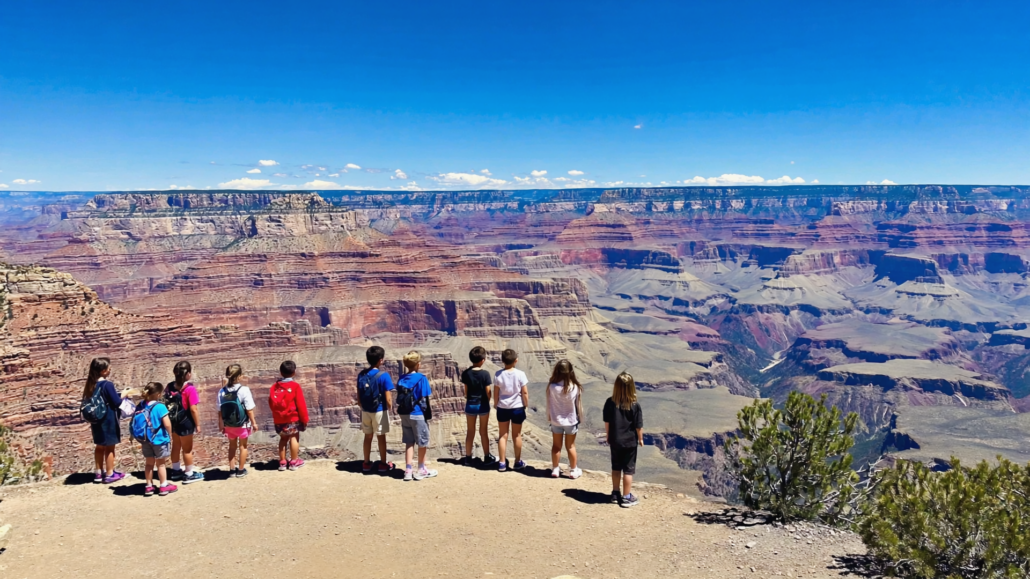
Grand Canyon for School Groups: Educational Programs, Planning Resources, and On-Site Orientation Options
Picture this: forty-two sixth graders stepping off a school bus in Tusayan, Arizona, squinting into the bright desert sun. They’ve read about the Grand Canyon in textbooks. They’ve watched clips on classroom screens. But in about twenty minutes, they’re going to see it projected across six stories of pure IMAX screen, and not one of them knows what’s about to happen. That moment, right before the lights go down and the canyon fills the room, is where a classroom lesson becomes something students carry with them for decades.
Planning a school trip to the Grand Canyon takes more than booking a bus and packing lunches. The canyon is vast, the logistics are genuinely complex, and the gap between a forgettable field trip and a transformative educational experience often comes down to preparation. This guide is built specifically for teachers, trip organizers, and curriculum coordinators who want to make every minute count, from the first stop in Tusayan to the last ranger-led program on the rim.
Why the Grand Canyon Belongs on Every School Itinerary
The Grand Canyon is one of the most concentrated classrooms on Earth. In a single site, students encounter living geology, Indigenous history spanning millennia, desert ecology, river science, and the policy history of America’s national park system. No textbook can replicate the cognitive impact of standing at the rim and processing a one-mile vertical drop with their own eyes.
The canyon’s rock layers alone tell a story stretching back nearly two billion years. The Vishnu Basement Rocks at the canyon floor are among the oldest exposed rocks on the continent, while the Kaibab Limestone at the rim formed roughly 270 million years ago. That range, compressed into a single visible cross-section, makes abstract geological timescales suddenly concrete. A student who has stood at Mather Point and traced those layers with their finger understands deep time in a way no diagram can deliver.
Beyond geology, the Colorado River corridor represents one of the most ecologically diverse environments in the American Southwest. From the riparian habitat at the river level to the pinyon-juniper woodland at the rim, the canyon contains multiple distinct ecological zones stacked vertically. Teachers covering life science, food webs, or adaptation find that the canyon provides a living laboratory that textbooks simply cannot replicate.
The human history dimension adds another layer. The Grand Canyon has been home to Indigenous peoples for thousands of years, and the National Park Service’s cultural history resources document the presence of at least eleven affiliated tribes who maintain deep cultural and spiritual connections to the canyon landscape. For social studies and history classes, that context transforms a geological wonder into a site of living human significance.
Then there is the national parks angle itself. Grand Canyon National Park was established in 1919, following Theodore Roosevelt’s designation of the Grand Canyon as a national monument in 1908. Understanding why that designation happened, and how the national park system has evolved since, opens conversations about conservation policy, public land management, and civic responsibility that connect directly to social studies standards across grade levels.
Starting Smart: Orientation Before the Rim
The single most effective thing a school group can do to improve the quality of their Grand Canyon visit is to orient students before they enter the park. Groups that arrive at the rim without context often spend the first critical hour in a state of overwhelm, struggling to process what they’re seeing. Groups that arrive with a foundation, visual, geological, and historical, use that time far more productively.
Located in Tusayan just outside the South Rim entrance, Grand Canyon Visitor Center IMAX was built precisely for this kind of pre-park orientation. The facility sits just minutes from the South Rim gates, making it a natural first stop for school groups arriving from the south. Rather than routing students directly into Grand Canyon National Park with no context, a stop here builds the intellectual framework that makes everything they see on the rim more meaningful.
Grand Canyon: Rivers of Time on a Six-Story IMAX Screen
The centerpiece of the orientation experience is the flagship film “Grand Canyon: Rivers of Time,” shown on a six-story IMAX screen using IMAX with Laser technology. For students who have never seen a large-format film, the scale alone is transformative. For students who have, the content raises the bar considerably.
The film walks viewers through the geological and cultural history of the Grand Canyon, compressing billions of years of Earth history into an immersive cinematic experience. It covers the formation of rock layers, the carving action of the Colorado River, the Indigenous peoples who have called the canyon home, and the journey of early explorers. For teachers who have spent weeks building toward a canyon visit, watching students see those concepts brought to life at this scale is one of the more satisfying moments of any field trip.
From a practical standpoint, the IMAX experience also solves a real logistical problem: it gives the entire group a shared reference point. When a ranger later asks students what they know about the Tonto Platform or the Colorado River’s role in canyon formation, the group that watched “Rivers of Time” has a common visual vocabulary to draw from. That shared baseline makes guided programs, ranger talks, and self-guided exploration significantly more productive.
School groups should book IMAX tickets in advance, particularly during spring field trip season when demand peaks. Booking online also unlocks savings on IMAX tickets, which matters when you’re managing a group budget. The Grand Canyon Visitor Center IMAX also sells various National Park entrance passes on-site, which can save considerable time compared to purchasing them at the park entrance during busy periods.
Practical Facilities for Large Groups
Managing forty or fifty students through a field trip requires facilities that can handle the volume. Grand Canyon Visitor Center IMAX offers on-site dining through Pizza Hut Express and Explorers Café, a large souvenir and hiking gear retail store, and ample space for groups to gather and reorganize before heading into the park. For trip organizers, having a single, well-equipped stop before the park entry reduces the logistical friction that can derail a school day.
The facility also houses a Pink Jeep Tours office, with guided tours departing directly from the front door. Every Pink Jeep Tour originating from Grand Canyon Visitor Center IMAX includes a “Rivers of Time” IMAX ticket, which makes bundled tour experiences an efficient option for groups with tighter schedules. Pink Jeep is recognized as Best Tour Operator in the region, and their guided experiences are designed with varying group sizes in mind.
National Park Service Educational Programs at the South Rim
Grand Canyon National Park operates one of the most robust ranger-led educational programs in the national park system. Teachers who coordinate directly with the park in advance gain access to structured programs that align with curriculum standards and are led by naturalists and historians who know the canyon deeply.
The NPS Grand Canyon education page is the authoritative starting point for any teacher planning a curriculum-aligned visit. The park offers ranger-led programs across multiple subjects, including geology, ecology, Indigenous culture, and conservation. Many of these programs are designed for specific age groups and can be scheduled in advance for school groups.
Junior Ranger Program
The Junior Ranger Program is one of the most effective engagement tools available for school-age visitors at the Grand Canyon. Students receive a Junior Ranger activity booklet, complete activities tied to what they observe and learn during the visit, and earn an official Junior Ranger badge upon completion. The program is self-paced and can be woven into the day’s itinerary without disrupting scheduled programming.
For teachers, the Junior Ranger booklet functions as a structured observation journal, prompting students to engage actively with what they’re seeing rather than passively moving through the park. The activities are tiered by age group, so younger students and older students can both find appropriate challenges. Teachers often report that students who complete the Junior Ranger booklet leave with a stronger ability to articulate what they observed and why it mattered.
The program is free of charge, and booklets are available at the official Grand Canyon Visitor Center inside Grand Canyon Village (the NPS-operated facility, distinct from Grand Canyon Visitor Center IMAX in Tusayan). Trip organizers should note this distinction: the two facilities serve different purposes. The NPS center provides park-specific information, maps, and ranger access; Grand Canyon Visitor Center IMAX provides cinematic orientation, ticketing, dining, and tour booking before park entry.
Ranger-Led Programs and Interpretive Talks
Throughout the day at the South Rim, park rangers deliver scheduled interpretive programs at various locations including Mather Point, Yavapai Geology Museum, and Hermit’s Rest. These talks are open to all visitors and typically run 20 to 45 minutes. For school groups, catching one or two of these talks adds professional interpretation that supplements whatever pre-visit preparation the class has done.
The Yavapai Geology Museum deserves particular attention for science-focused groups. Positioned on the rim with panoramic views of the canyon, the museum’s interpretive displays connect what students can see directly in front of them, the rock layers, the river, the plateaus, to the geological processes that created them. The combination of interpretive panels and live canyon views makes the concepts unusually sticky for students.
Trip organizers who want scheduled ranger programs for their group specifically should contact the park’s education office well in advance. Walk-in ranger programs are available but scheduling a dedicated session ensures the program is tailored to the group’s age and curriculum focus.
Curriculum Connections Across Subject Areas
The Grand Canyon provides curriculum-aligned content across virtually every core subject area, making it one of the rare field trip destinations that satisfies multiple teachers on a single trip. Rather than treating the visit as a science field trip with everything else as background noise, effective trip organizers brief every teacher in the group on the interdisciplinary possibilities before departure.
Earth Science and Geology
The canyon’s rock sequence is a foundational teaching tool for stratigraphy, the study of rock layers and what they reveal about Earth’s history. The Law of Superposition, the principle that older rock layers lie beneath younger ones, is visually undeniable at the Grand Canyon. Students who have struggled with the concept in a classroom often grasp it immediately when they can point to the actual layers and name them.
Key formations to introduce students to before arrival include the Kaibab Limestone at the rim (containing marine fossils that demonstrate the canyon area was once covered by a shallow sea), the Redwall Limestone (the prominent red band visible from nearly any rim viewpoint), and the Vishnu Basement Rocks at the canyon floor (among the oldest exposed rocks in North America). Having students sketch the visible layers from a rim viewpoint and label them using a provided cross-section diagram is a classic and effective field activity.
The erosion story, how water, ice, and wind have carved and continue to shape the canyon, also connects to physical science standards around weathering, erosion, and deposition. The Colorado River, which still flows through the canyon floor, provides a live example of the process that created the landscape above it.
Life Science and Ecology
The canyon’s vertical range of nearly a mile creates what ecologists describe as a series of distinct life zones stacked on top of each other, each with its own characteristic plant and animal communities. The South Rim sits in a transition zone forest of ponderosa pine, while the canyon floor supports a Sonoran desert environment dramatically warmer and drier than the rim above.
Students studying adaptation, food webs, or biomes find the canyon particularly compelling because the ecological gradient is visible and walkable. The California condor, one of North America’s most successful endangered species recovery stories, nests in the canyon walls and is frequently visible soaring above the rim. Spotting a condor, with its distinctive nine-foot wingspan and identifying tags, is a memorable and teachable moment about conservation biology that students remember long after the trip.
For tips on observing canyon wildlife responsibly, the Grand Canyon wildlife watching guide covers what students are likely to encounter and how to engage respectfully with the ecosystem.
Social Studies, History, and Indigenous Cultures
The human history of the Grand Canyon spans thousands of years before the park’s establishment. Archaeological evidence shows human habitation of the canyon going back at least 12,000 years. The canyon contains hundreds of documented archaeological sites, including split-twig figurines found in caves within the canyon walls that date back roughly 4,000 years.
For social studies classes, the canyon offers entry points into discussions about Indigenous sovereignty and land relationships, the history of westward exploration (John Wesley Powell’s 1869 and 1872 Colorado River expeditions remain foundational narratives), the conservation movement and the creation of the national park system, and the ongoing relationship between tribal nations and federal land management. These topics connect to history, civics, and geography standards across middle and high school grade levels.
Language Arts and Creative Writing
The Grand Canyon has inspired some of the most vivid descriptive writing in American literature. Standing at the rim with a notebook is a genuinely effective prompt for students working on descriptive writing, sensory detail, and figurative language. The scale of the canyon challenges students to find language adequate to the experience, which is itself a valuable writing exercise.
Assigning a pre-trip reading from John Muir, Theodore Roosevelt’s famous “leave it as it is” speech, or contemporary nature writing about the canyon gives students a literary context for their own observations. Post-trip writing assignments that ask students to compare their experience with the text they read before the visit produce some of the strongest reflective writing teachers report from any field trip.
Planning the Day: A Practical Framework for School Groups
Effective Grand Canyon school trips follow a deliberate sequence: orient, explore, consolidate. Groups that skip the orientation phase or attempt to cover too much ground typically end the day with students who are visually overwhelmed but intellectually underwhelmed. Focused itineraries produce better learning outcomes and better behavior.
Sample School Day Framework
| Time Block | Activity | Location | Learning Focus |
|---|---|---|---|
| 8:30 – 9:30 AM | IMAX film “Grand Canyon: Rivers of Time” | Grand Canyon Visitor Center IMAX, Tusayan | Geological history, cultural overview, visual orientation |
| 9:30 – 10:00 AM | Park pass purchase, group reorganization, snack break | Grand Canyon Visitor Center IMAX, Tusayan | Logistics, student briefing |
| 10:00 – 10:30 AM | Drive into park, initial rim arrival at Mather Point | Grand Canyon National Park, South Rim | First observation, supervised rim experience |
| 10:30 – 11:30 AM | NPS Visitor Center, Junior Ranger booklet distribution, ranger talk | Grand Canyon Village, NPS Visitor Center | Curriculum-aligned interpretation, structured activity |
| 11:30 AM – 1:00 PM | Rim Trail walk, sketch and observation activity | South Rim Trail | Field observation, scientific drawing, descriptive writing |
| 1:00 – 1:45 PM | Lunch break | Designated picnic area or return to Tusayan | Rest, group discussion |
| 1:45 – 3:00 PM | Yavapai Geology Museum or Bright Angel Trail head (short section) | South Rim | Geology deep dive, physical activity, ecosystem observation |
| 3:00 – 3:30 PM | Junior Ranger badge ceremony, group debrief | NPS Visitor Center or rim viewpoint | Reflection, consolidation, recognition |
This framework is a starting point, not a prescription. Schools arriving from farther away may need to compress the schedule. Groups with specific curriculum goals may want to spend more time at the Yavapai Geology Museum or request a dedicated ranger program. The important principle is sequencing: orient before exploring, and consolidate before departing.
Group Size Management and Safety
The South Rim’s paved rim trail is accessible and manageable for school groups, but the canyon environment demands specific safety protocols that differ from typical field trips. The most important rule is deceptively simple: students do not approach the edge of the canyon without a chaperone within arm’s reach. The rim has guardrails at most viewpoints, but sections of the Rim Trail and many informal viewpoints do not. Pre-trip briefings on rim safety are not optional.
A standard ratio for rim-adjacent activities is one adult chaperone for every eight to ten students, with higher ratios for younger groups. Group leaders should designate a specific meeting point at each viewpoint before students scatter, and headcounts should happen every time the group transitions between locations.
Hydration is a non-negotiable safety issue, even at the rim. The high desert environment at the South Rim (elevation approximately 7,000 feet) is significantly drier than most students are accustomed to, and the combination of altitude and low humidity accelerates dehydration faster than students typically expect. Each student should carry a minimum of one liter of water for a half-day rim visit, more for groups doing any trail walking.
Transportation and Parking Logistics
School buses present specific parking considerations at the South Rim. Grand Canyon National Park maintains designated bus parking areas near the main visitor hub at Grand Canyon Village, but these fill quickly during peak spring and summer periods. Trip organizers should contact the park’s transportation desk in advance to confirm available bus parking and access routes.
The park’s free shuttle bus system covers the major South Rim viewpoints along the Village and Hermit Rest routes. School groups can use the shuttle to move between viewpoints without the logistics of relocating a bus, which simplifies the day considerably. The shuttle is accessible and can accommodate large groups across multiple vehicles if needed.
For groups arriving in passenger vehicles or smaller vans, the Tusayan shuttle service offers an alternative approach to the park that bypasses the entrance gate queues during peak hours, which is worth understanding as part of the broader transportation planning for any large group.
What to Prepare Before the Trip: Teacher Toolkit
The quality of a Grand Canyon field trip is largely determined before the bus ever leaves the school parking lot. Groups that arrive with a shared vocabulary, a list of questions to answer, and some prior exposure to the canyon’s visual geography consistently report richer experiences than groups who treat the trip as a first encounter.
Pre-Visit Classroom Activities
A two to three week pre-visit unit significantly increases the educational return on a single field day. The following sequence has proven effective across grade levels:
- Week One: Geological Foundation. Introduce the concept of geological time using the canyon’s rock sequence as a framework. Have students create a timeline that compresses Earth’s history to a single school year, placing the canyon’s oldest rocks, the formation of the Colorado River plateau, and the beginning of human habitation at appropriate points.
- Week Two: Ecological and Human History. Cover the canyon’s major life zones, introduce the concept of adaptation using canyon-specific animals (condor, ringtail cat, Kaibab squirrel), and survey the history of Indigenous peoples and European exploration of the canyon.
- Week Three: Field Preparation. Assign specific observation tasks each student will complete during the visit, distribute field journals, review safety protocols, and watch a short preview of what IMAX large-format film looks like so students aren’t distracted by the format itself during “Rivers of Time.”
The NPS provides free downloadable curriculum resources specifically designed for Grand Canyon teacher preparation. The Grand Canyon curriculum materials page includes lesson plans organized by grade level and subject area, many of which align to Next Generation Science Standards and Common Core literacy standards.
Field Journals and Observation Prompts
A simple field journal, even a folded piece of cardstock with printed prompts, dramatically increases student engagement during the visit. Effective prompts move students from passive looking to active observation. Examples that work well at the Grand Canyon include:
- “Sketch three distinct rock layers you can see from your current viewpoint. What color is each layer? What does the texture suggest about how it was formed?”
- “Find an example of a plant or animal that appears adapted to the canyon environment. Describe the adaptation and hypothesize what problem it solves.”
- “Write three sentences describing the canyon using only what you can directly observe, no background knowledge. Then write three more sentences explaining what those observations tell you about Earth’s history.”
- “What is one question the canyon raises for you that your textbook hasn’t answered? Write it down. Try to find the answer before the day ends.”
These prompts work equally well for science, language arts, and social studies objectives, and they give chaperones a structured way to engage students at viewpoints without requiring specialized knowledge.
Age-Specific Recommendations: Matching Programs to Grade Levels
Not every Grand Canyon experience is appropriate for every age group, and the most effective school trips calibrate the depth and format of activities to the developmental stage of the students. A program that captivates a group of tenth graders may be completely inaccessible to second graders, and vice versa.
| Grade Band | Recommended Focus Areas | Best Experiences | Notes for Organizers |
|---|---|---|---|
| K–2 | Sensory observation, basic ecology, “big and small” scale concepts | IMAX film, Mather Point viewpoint, Junior Ranger booklet (early reader version) | Keep itinerary short. Focus on experience over content delivery. Higher chaperone ratios essential. |
| 3–5 | Rock layers, erosion basics, canyon wildlife, national park history | IMAX film, ranger talk, Junior Ranger program, Rim Trail walk with observation prompts | Junior Ranger activities are highly effective at this age. Pre-visit vocabulary building pays off significantly. |
| 6–8 | Stratigraphy, ecological zones, Indigenous history, John Wesley Powell narrative | IMAX film, Yavapai Geology Museum, Bright Angel trailhead walk, dedicated ranger program | This age group benefits most from structured inquiry. Field journals with specific prompts produce strong post-trip work. |
| 9–12 | Geological dating, conservation policy, tribal sovereignty, climate and erosion patterns | IMAX film, ranger-led geology program, short trail hike below rim (with appropriate preparation), primary source analysis | High schoolers respond well to policy and ethics discussions grounded in the canyon’s management history. Connect to current curriculum units. |
The IMAX Experience as a Curriculum Anchor
For school groups, the IMAX film “Grand Canyon: Rivers of Time” functions most effectively not as entertainment, but as a curriculum anchor, a shared reference point that all subsequent learning builds from. Teachers who brief students on what to watch for before the film begins, and debrief immediately after, report significantly stronger knowledge retention from the day’s overall experience.
Before entering the Grand Canyon IMAX Theater, give students a brief watching guide with three to five specific things to look for: the sequence of rock layers visible in the canyon walls, the role of the Colorado River in canyon formation, evidence of human history within the canyon, examples of canyon wildlife, and the scale of the canyon relative to familiar landmarks. Framing these as “observation tasks” rather than “things to find” keeps students actively engaged with the content rather than passively watching.
The six-story IMAX screen using IMAX with Laser technology delivers a visual impact that standard classroom media simply cannot match. For many students, seeing the canyon at this scale for the first time triggers the kind of genuine curiosity that makes the subsequent park visit far more productive. Questions that would never arise in a classroom, “How long did it take for the river to carve that deep?” or “How do people even get down to the bottom?” emerge naturally after the film, and those questions are exactly what rangers and field programs are designed to answer.
Post-film, teachers can use a quick five-minute verbal debrief while students are still seated to surface initial reactions and questions. Write those questions down. They become the inquiry agenda for the day. This approach, rooting the day’s learning in student-generated questions rather than teacher-delivered content, aligns with inquiry-based learning frameworks and tends to produce more engaged, self-directed exploration during the park visit itself.
Groups booking IMAX tickets in advance can save on admission. Booking IMAX online means the savings go directly back into the trip budget, which matters for school groups managing tight per-student costs. The Grand Canyon Visitor Center IMAX also sells various National Park entrance passes on-site, which eliminates one more queue from a day that already has plenty of logistical moving parts.
Seasonal Timing: When to Plan Your School Trip
The Grand Canyon South Rim is accessible year-round, but school groups face meaningfully different conditions depending on when they visit. Understanding the seasonal trade-offs helps trip organizers set realistic expectations and prepare students appropriately.
Spring (March through May) is the most popular season for school field trips, and for good reason. Temperatures at the rim are mild, ranging from roughly 40°F to 70°F, wildflowers are often visible along the Rim Trail, and the park’s natural lighting is at its most dramatic. The trade-off is crowd density: spring break periods and late April bring peak visitor volumes, which can mean longer waits at viewpoints and limited bus parking. Groups planning spring visits should book IMAX tickets, park passes, and any guided programs as early as possible.
Fall (September through November) offers an excellent balance of manageable crowds and comfortable temperatures. The cottonwood trees along the canyon’s inner gorge turn gold in October, adding a visual dimension that students from warmer states rarely see in their home environments. Fall is increasingly popular for educational travel as schools look to avoid the spring crunch, and the Grand Canyon Visitor Center IMAX remains fully operational through the fall season.
Winter (December through February) brings genuine quiet to the South Rim, along with the possibility of snow on the canyon’s upper walls, one of the most visually striking conditions the canyon offers. Temperatures can drop below freezing, so cold-weather preparation is essential. The reward is an uncrowded, serene environment where students often engage more deeply because the typical tourist-season noise is absent.
Summer (June through August) is manageable at the rim level, where elevation keeps temperatures cooler than the surrounding desert, but summer crowds are at their peak. Groups visiting in summer should plan for earlier arrival times to secure parking and avoid midday heat. The IMAX theater provides a welcome air-conditioned orientation environment before students head into the heat of the park.
Frequently Asked Questions for School Trip Organizers
How far in advance should we book IMAX tickets for a school group?
For spring visits, booking at least six to eight weeks in advance is strongly recommended. Spring is peak school trip season at the Grand Canyon, and large-format screenings fill quickly with both school groups and general visitors. Fall visits can typically be booked with less lead time, but advance booking is always preferable. Booking online also unlocks savings on IMAX tickets, which helps stretch school trip budgets.
Is Grand Canyon Visitor Center IMAX the same as the NPS Visitor Center inside the park?
No, these are two distinct facilities. Grand Canyon Visitor Center IMAX is a privately operated facility located in Tusayan, Arizona, just outside the South Rim entrance gates. It houses the Grand Canyon IMAX Theater, dining, retail, Pink Jeep Tours, and park pass sales. The NPS Visitor Center is the official National Park Service facility inside Grand Canyon Village, within the park boundary, and provides ranger programs, Junior Ranger booklets, and park information. Both facilities serve important and complementary roles for school groups, and most itineraries benefit from visiting both.
What is the Grand Canyon IMAX film about, and is it appropriate for all ages?
“Grand Canyon: Rivers of Time” covers the geological history, cultural heritage, and natural wonders of the Grand Canyon. It is appropriate for all school age groups, though the depth of engagement naturally increases with older students who have more background knowledge. For younger students, the visual scale of the six-story IMAX screen using IMAX with Laser technology is itself a memorable and engaging experience regardless of how much of the content they absorb.
Can we do the Junior Ranger program on a single-day visit?
Yes. The Junior Ranger booklet is designed to be completable during a standard day visit to the South Rim. Students work through the activities as they move through the park, and the badge ceremony at the end of the day provides a satisfying conclusion to the visit. Teachers should pick up booklets from the NPS Visitor Center early in the day so students have maximum time to complete the activities.
How do we purchase park entrance passes for a school group?
Grand Canyon Visitor Center IMAX in Tusayan sells various National Park entrance passes on-site before you enter the park, which can save significant time compared to purchasing at the entrance gate during peak periods. America the Beautiful passes, which cover entrance fees to all federal lands for a year, are often a cost-effective option for school districts that visit multiple national parks. Contact the park’s fee office directly for information on any applicable group or educational visit fee structures.
Are there specific programs for high school students, or is everything geared toward younger kids?
The NPS offers ranger-led programs across all age levels, and many of the most sophisticated interpretive talks are specifically designed for adult and high school audiences. The Yavapai Geology Museum’s interpretive content is particularly strong for high school earth science. Pre-scheduled dedicated ranger programs, arranged in advance through the park’s education office, can be tailored to high school curriculum standards including NGSS and Advanced Placement Earth Science content.
What is the best trail for a school group to walk at the South Rim?
The paved Rim Trail between Mather Point and Bright Angel Trailhead is the most accessible and manageable option for school groups. It is flat, wide, and offers multiple viewpoints with guardrails. The section from Mather Point to Yavapai Point (approximately one mile) is particularly well-suited to school groups because it passes both the NPS Visitor Center and the Yavapai Geology Museum, allowing for educational stops along the route. Groups with older students in good physical condition can walk short sections of the Bright Angel Trail below the rim, but this requires specific safety briefing and higher chaperone ratios.
Does Pink Jeep Tours offer programs for school groups?
Pink Jeep Tours, operating from the Grand Canyon Visitor Center IMAX with tours departing from the front door, offers guided experiences of the canyon’s rim and surrounding geology. Every Pink Jeep Tour originating from Grand Canyon Visitor Center IMAX includes a “Rivers of Time” IMAX ticket, making bundled experiences an efficient option for school groups. Contact the Pink Jeep Tours office at Grand Canyon Visitor Center IMAX directly to discuss group availability and scheduling.
How do we handle students with mobility limitations at the Grand Canyon?
The South Rim is significantly more accessible than most people expect. The paved Rim Trail is accessible, the NPS Visitor Center and Yavapai Geology Museum are fully accessible, and the park’s shuttle system accommodates wheelchairs and mobility devices. The Grand Canyon Visitor Center IMAX facility in Tusayan is fully accessible. Trip organizers should contact both the NPS accessibility office and the Grand Canyon Visitor Center IMAX in advance to confirm current accessibility conditions and accommodations.
What should students wear and bring for a full-day South Rim visit?
Layered clothing is essential at the South Rim regardless of season, as temperatures can shift significantly between morning and afternoon. Closed-toe shoes with good grip are required for any trail walking. Each student should carry a minimum of one liter of water, and students doing any trail walking below the rim should carry more. Sun protection (sunscreen, hat, sunglasses) is important year-round due to the high altitude and intense UV exposure at 7,000 feet. Field journals, pencils, and a camera or phone for documentation round out the essential student kit.
Are there interesting things to learn about the canyon’s human history that go beyond standard geology content?
The human history dimension of the Grand Canyon is rich and often undertaught. The canyon’s Indigenous history spans thousands of years and involves multiple tribal nations whose cultural connections to the landscape remain active today. The Havasupai Tribe, the Hualapai Nation, the Navajo Nation, and the Hopi are among the eleven tribes with affiliated status. John Wesley Powell’s 1869 first navigation of the Colorado River through the canyon is one of the great exploration narratives in American history. And the political story of how the canyon became a national park, including the role of John Muir and Theodore Roosevelt, provides an entry point into conservation history that connects to current civics and environmental policy discussions.
What makes “Grand Canyon: Rivers of Time” particularly effective as an educational orientation tool?
The combination of large-format visual storytelling and factual geological and cultural content addresses a fundamental challenge of Grand Canyon education: the canyon is so vast that it’s difficult to comprehend without a framework. The film provides that framework before students arrive at the rim, so their first look at the canyon is informed rather than overwhelming. The six-story IMAX screen using IMAX with Laser technology delivers geological formations at a scale that makes the abstract concrete, which is precisely the cognitive function that makes pre-visit orientation so valuable for school-age learners.
Key Takeaways for School Trip Organizers
- Orient before you explore. A stop at Grand Canyon Visitor Center IMAX in Tusayan for the “Grand Canyon: Rivers of Time” IMAX film provides the shared visual and intellectual foundation that makes the subsequent park visit dramatically more productive for students at every grade level.
- Two visitor centers, two roles. Grand Canyon Visitor Center IMAX (Tusayan, privately operated) and the NPS Visitor Center (inside the park at Grand Canyon Village) serve different functions. A well-planned school trip benefits from both.
- Pre-visit preparation multiplies field day value. A two to three week pre-visit unit, supported by NPS curriculum materials, produces students who engage more deeply, ask better questions, and retain more from the experience.
- The Junior Ranger Program is a structured engagement tool, not just a souvenir. The activity booklet functions as a guided observation journal that keeps students actively engaged throughout the park visit.
- Sequence matters. Orient, explore, consolidate. Groups that follow this sequence consistently report more meaningful student experiences than groups that attempt to cover everything without a structure.
- Book early for spring visits. IMAX tickets, ranger programs, and bus parking all fill quickly during peak spring field trip season. Book online to save on IMAX admission and lock in availability.
- The canyon is interdisciplinary. Earth science gets the headline, but social studies, language arts, life science, and civics all have strong curriculum connections at the Grand Canyon. Brief every teacher in the group, not just the science teacher, on what to look for.
- Safety protocols are non-negotiable at the rim. Review all rim safety guidelines with students and chaperones before arrival. Hydration, sun protection, and supervised proximity to the rim are the three most important safety priorities for school-age visitors.

About the author
Explore The Canyon Editorial Team
See The Canyon

