
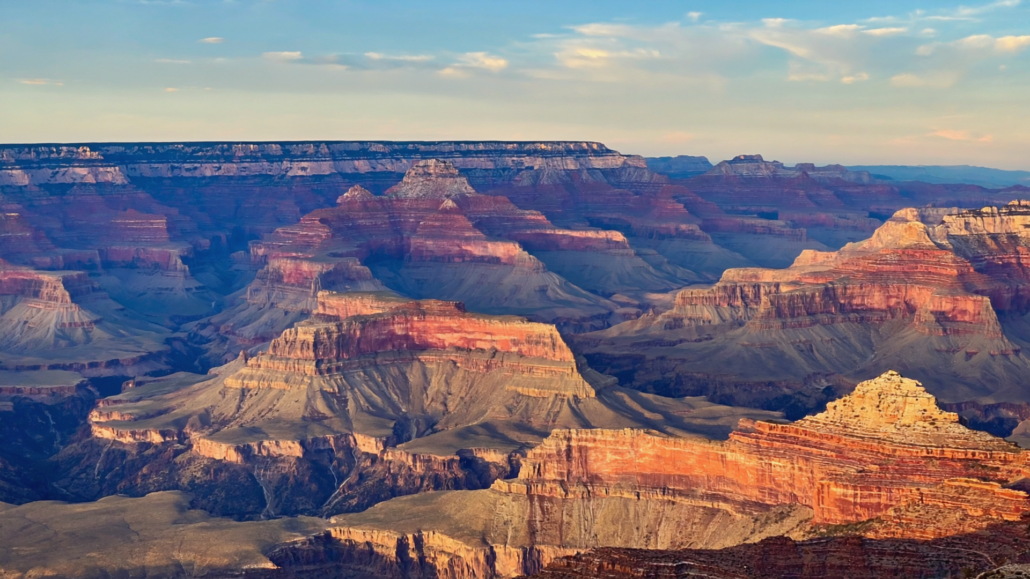
The Cultural Heritage of the Grand Canyon: Indigenous History, River Explorers, and Living Traditions
Most visitors arrive at the Grand Canyon expecting geology. They get something far more layered: a landscape that has been home, highway, sacred ground, and scientific frontier for at least 12,000 years of continuous human presence. The rock tells one story. The people tell another. And the two are inseparable in ways that most travel guides barely scratch.
The Grand Canyon is not simply a hole in the ground carved by water and time. It is an archive of human civilization, a contested homeland, a place of origin stories, a route of exploration, and a living cultural landscape that eleven distinct Indigenous nations still call their own. Understanding that full story transforms a sightseeing trip into something genuinely meaningful, and it makes the canyon itself more vivid, not less.
This article is a deep dive into the Grand Canyon’s cultural history: who lived here and when, what the Spanish and American explorers found, how the river expeditions changed science, and why Indigenous heritage is not a chapter in the past tense but a present-day reality that every visitor should understand. Whether you are planning a first visit or your fifth, this is the context that makes the canyon come alive.
The First 12,000 Years: Indigenous Nations and the Canyon’s Human Timeline
The Grand Canyon’s human story begins at the end of the last Ice Age, when the first Paleo-Indian peoples moved through the Colorado Plateau following megafauna across a transformed landscape. The canyon was not a barrier to these early inhabitants. It was a corridor, a resource, and, in time, a home.
Archaeological evidence gathered over decades of survey work by the National Park Service’s Grand Canyon cultural resources program confirms that human occupation of the canyon and its rims extends back roughly 10,000 to 12,000 years. The physical record includes split-twig figurines found in inner canyon caves, some dating to approximately 4,000 years ago, that represent deer or bighorn sheep and are believed to have served ceremonial or hunting-magic purposes. These small, carefully constructed objects offer a rare window into the spiritual life of people whose names we do not know.
Over subsequent millennia, distinct cultures rose, adapted, and moved through the canyon landscape. The Ancestral Puebloans (historically called Anasazi, though many tribal members prefer the former term) built granaries, cliff dwellings, and agricultural terraces along the canyon walls. Their masonry structures, some still visible from rim trails today, demonstrate sophisticated engineering adapted to an extreme environment. The Ancestral Puebloan presence at the Grand Canyon peaked roughly 800 to 1,100 years ago before a combination of drought, resource pressure, and migration shifted population centers eastward toward the Rio Grande valley, where their descendants, the modern Pueblo peoples, live today.
The Eleven Affiliated Tribes
Today, eleven Indigenous nations maintain formal ties to the Grand Canyon landscape, recognized through the National Park Service’s tribal consultation process and through the groups’ own ancestral and legal connections to the land. These nations are not remnants of a distant past. They are active communities with governments, cultural programs, language revitalization efforts, and ongoing relationships with a landscape their ancestors have inhabited for generations.
The Havasupai Tribe holds perhaps the most well-known claim to canyon life. The Havasupai have lived within the canyon itself, specifically in the Havasu Canyon side canyon, for at least 800 years by their own accounting, with deep roots extending much further. Their reservation, the smallest in the United States, sits at the bottom of a canyon accessible only by an 8-mile trail, helicopter, or horse. The name Havasupai translates roughly as “people of the blue-green water,” a reference to the mineral-rich turquoise waterfalls that flow through their village of Supai. For much of the 20th century, federal land policies dramatically reduced Havasupai territory. A landmark 1975 act of Congress restored approximately 185,000 acres to the tribe, one of the largest land restorations in American history at that time.
The Hualapai Tribe occupies the South Rim’s western section, a 108-mile stretch of canyon rim that includes the Grand Canyon Skywalk, a glass-bottomed bridge extending over the canyon. The Hualapai are active stewards of their section of the canyon and operate their own tourist infrastructure, including helicopter tours and river float trips.
The Navajo Nation, the largest Native American nation by land area in the United States, borders the canyon to the east at the Desert View/eastern corridor area. Navajo cultural sites, stories, and land use patterns are woven through the canyon’s eastern reaches, and the Nation maintains active consultation relationships with the National Park Service on management decisions affecting their ancestral territory.
The Hopi Tribe traces its ancestry directly to the Ancestral Puebloans who built the canyon’s cliff dwellings. For the Hopi, the Grand Canyon is the Sipapuni, the place of emergence where the Hopi people entered this world from the one below. This is not metaphor for the Hopi; it is literal sacred geography. The Hopi Tribe is among the most vocal in insisting that management decisions about the canyon treat it as a living sacred landscape rather than a passive natural monument.
The remaining affiliated tribes include the Zuni Tribe, the Kaibab Band of Paiute Indians, the Las Vegas Band of Paiute Indians, the Moapa Band of Paiute Indians, the Paiute Indian Tribe of Utah, the San Juan Southern Paiute Tribe, and the Yavapai-Apache Nation. Each maintains distinct cultural, linguistic, and historical relationships with the canyon that are as different from one another as the canyon’s own geological strata.
What This Means for Visitors
Understanding tribal connections to the Grand Canyon shapes how a thoughtful visitor experiences the place. Rock art sites, archaeological features, and certain areas of the canyon hold deep cultural significance. The Leave No Trace ethic takes on additional meaning here: disturbing archaeological sites is not only illegal under the Archaeological Resources Protection Act, it is a genuine harm to living communities whose heritage is embedded in those materials.
Spanish Exploration and the Canyon’s First European Encounter
The European discovery of the Grand Canyon is a story of accidental arrival and strategic retreat. In 1540, just 48 years after Columbus’s first voyage, a small detachment from Francisco Vásquez de Coronado’s massive expedition became the first Europeans to lay eyes on the canyon. Led by García López de Cárdenas, this group was guided by Hopi people to the South Rim after reports of a great river below.
What Cárdenas and his men encountered stopped them cold. They spent three days attempting to find a route to the river below, motivated primarily by the need for water. Their best climbers descended partway into the canyon before turning back, reporting that what appeared from the rim to be man-sized rocks were actually towers taller than the great tower of Seville. The canyon’s capacity to deceive scale and distance, something every modern visitor experiences, was noted by the very first Europeans to see it.
Cárdenas reported the canyon as an impassable obstacle and returned to the main expedition. The Spanish did not return to the canyon for more than 200 years. When they did, in 1776, it was as part of Father Francisco Tomás Garcés’s journey along the canyon’s south side, during which he made contact with the Havasupai and spent five days in Havasu Canyon. That same year, Fathers Francisco Atanasio Domínguez and Silvestre Vélez de Escalante attempted to find a northern route from Santa Fe to California, crossing the Colorado River at what is now known as the Crossing of the Fathers in the canyon’s upper reaches.
The Spanish colonial period left relatively light direct marks on the canyon itself, partly because the canyon resisted colonization. Its depth, its aridity, and its Indigenous defenders made it a poor target for mission establishment or mining extraction. But the Spanish period did establish the geographic knowledge, the river names, and the early cartographic framework that American explorers would later build on.
The Mexican Period and the Fur Trade Era
After Mexican independence in 1821, the canyon’s territory fell under Mexican jurisdiction, though effective governance barely reached the Colorado Plateau. American mountain men and fur trappers began crossing the region in the 1820s. James Ohio Pattie claimed in his 1831 memoir to have traveled along the canyon rim, though historians debate the accuracy of his account. What is clear is that by the 1840s, American military and scientific expeditions were actively mapping the Southwest, and the Colorado River and its great canyon were understood to be major geographical features that demanded investigation.
The Powell Expeditions: Science, Adventure, and the River Below
No single chapter of Grand Canyon exploration has captured the public imagination as thoroughly as John Wesley Powell’s expeditions down the Colorado River. In 1869, Powell led a crew of nine men in four wooden boats from Green River, Wyoming, through the length of the Grand Canyon, emerging at the mouth of the Virgin River 99 days later. It was the first documented passage of the canyon by boat, and it transformed American understanding of the West’s geography.
Powell was a Union Army veteran who had lost his right arm at the Battle of Shiloh. He was also a self-taught geologist and ethnologist with a gift for scientific observation and an instinct for the dramatic. His written account of the 1869 expedition, later expanded and combined with observations from his 1871-1872 repeat journey, remains one of the great documents of American exploration literature. His descriptions of the canyon’s geological layers, its tributaries, its rapids, and its moods set the template for how educated Americans would understand the place for generations.
What Powell observed in the canyon’s walls was, in the language of the time, revolutionary. The exposed strata represented an almost unbroken record of Earth’s geological history, layer upon layer of sedimentary and metamorphic rock that, when read correctly, told a story of shallow seas, desert dunes, volcanic activity, and slow uplift spanning hundreds of millions of years. Powell understood that he was looking at deep time in a way that most Americans had not yet conceptually accepted, Darwin’s On the Origin of Species had been published only ten years before, and the idea of Earth as billions of years old was still culturally unsettled.
The Geological Story Powell Helped Decode
The Grand Canyon’s geology history, as Powell helped establish it, is a story told in distinct chapters. At the canyon’s rim, the Kaibab Limestone is approximately 270 million years old, laid down in a warm, shallow sea during the Permian period. As you descend, each layer represents an older environment: the Coconino Sandstone below it formed from ancient sand dunes, the Hermit Formation from river floodplains, the Supai Group from coastal environments. The deeper you go, the further back in time you travel.
Near the river itself, the Vishnu Schist, the dark basement rock visible at river level, is among the oldest exposed rock in North America, with ages measured at roughly 1.7 to 1.8 billion years. This is Precambrian rock, formed before complex life existed on Earth. The Colorado River, running through this ancient material, is comparatively young, having carved the canyon to its current depth over approximately 5 to 6 million years.
One of the canyon’s most fascinating geological features, and one that Powell’s expeditions helped bring to scientific attention, is what geologists call the Great Unconformity: a boundary between the ancient Vishnu Schist and the younger Tonto Group sedimentary rocks above it that represents a gap in the rock record of roughly 1.2 billion years. That gap, visible as a sharp line in the canyon walls, represents an enormous span of geological time for which the canyon has no physical record. Entire mountain ranges rose and eroded away during that missing interval, leaving no trace in the strata.
Powell’s Legacy Beyond the Canyon
Powell’s impact extended well beyond exploration. His foundational work at the U.S. Geological Survey, which he directed from 1881 to 1894, established the framework for federal land management, watershed-based governance, and scientific understanding of the arid West. His warnings about the limits of water availability in the Colorado River basin, warnings that contemporary water managers are now urgently revisiting, were ahead of their time by a century. Powell argued that settlement and agriculture in the West should follow watershed boundaries rather than arbitrary political lines, advice that was largely ignored in his lifetime and is now painfully relevant.
For Grand Canyon cultural history, Powell’s expeditions mark the moment when the canyon entered the American national imagination as a place of both scientific importance and romantic grandeur. His accounts, combined with the paintings of Thomas Moran and the photographs of Jack Hillers from the 1871-1872 expedition, created the visual vocabulary through which Americans first understood what the Grand Canyon looked like.
The Railroad Era and the Birth of Grand Canyon Tourism
The transformation of the Grand Canyon from scientific curiosity to national destination happened quickly once the railroad arrived. The Atchison, Topeka and Santa Fe Railway completed a spur line from Williams, Arizona, to the South Rim in 1901, reducing the journey from a multi-day stagecoach ordeal to a comfortable few hours from Flagstaff. Within a decade, thousands of tourists were arriving annually, and the infrastructure of modern Grand Canyon tourism was taking shape.
Fred Harvey, the legendary hospitality entrepreneur who partnered with the Santa Fe Railway throughout the Southwest, established the Bright Angel Hotel at the rim and eventually the El Tovar Hotel, which opened in 1905. El Tovar, designed by architect Charles Whittlesey in a rustic European hunting lodge style, set the aesthetic tone for South Rim development and still stands today as a National Historic Landmark. The Harvey Company also actively promoted Navajo and Hopi crafts through its gift shops and cultural displays, a practice that, while commercially motivated, helped sustain Indigenous artisanal traditions through the early 20th century.
President Theodore Roosevelt visited the Grand Canyon in 1903 and famously urged Americans to leave it unimpaired for future generations. His visit accelerated the push for formal federal protection. The canyon became a National Monument in 1908 under the Antiquities Act and achieved full National Park status in 1919, just after the end of World War I.
Tourism, Photography, and the Canyon’s Visual Identity
The early 20th century established the South Rim’s visual grammar: the viewpoints, the trails, the named overlooks. Photographers and painters from the region’s art colonies helped fix the canyon’s image in American cultural consciousness. Ansel Adams photographed the canyon repeatedly, contributing to the visual archive that defined how Americans related to the landscape. The Grand Canyon became not just a destination but a symbol, appearing on everything from railway promotional posters to postage stamps, encoding the canyon as a shorthand for American natural grandeur.
Living Traditions: Indigenous Culture at the Canyon Today
The most important correction to the conventional tourist narrative of the Grand Canyon is this: Indigenous history here is not past tense. The eleven affiliated tribes are not historical footnotes. They are governments, communities, and cultures actively engaged with the canyon’s present and future management.
The Havasupai Tribe operates the only functioning village inside the Grand Canyon. Supai, their community of several hundred residents, is accessible only by the 8-mile Havasupai Trail, helicopter, or pack horse, making it one of the most remote communities in the contiguous United States. The tribe manages its own tourism program, including a campground and a lodge, and has become increasingly selective about visitor numbers in response to overuse impacts on their sacred landscape. This is their home, not a theme park, and the Havasupai have been clear about the distinction.
The Hualapai Tribe’s Grand Canyon West development, on the western section of the canyon, represents a different model of Indigenous-led tourism. The Skywalk, which opened in 2007, was conceived and developed by Hualapai leadership as an economic development project for a reservation community with high unemployment. It generates revenue that funds tribal government services, education, and infrastructure. Whatever one thinks of the architectural intervention on the canyon landscape, it is a project of Indigenous self-determination in the economic sphere.
Language preservation is one of the most active areas of cultural work among canyon tribes. The Havasupai language, Havasupai-Walapai-Yavapai (a dialect continuum shared with the Hualapai and Yavapai-Apache), is the subject of active revitalization programs. Hopi language instruction has been integrated into tribal school curricula. The Navajo Nation operates an extensive bilingual education program across its territory. These efforts reflect an understanding that language is not merely communication; it is the carrier of cultural knowledge about the land, including knowledge about the canyon itself that exists nowhere in English-language scientific literature.
Sacred Site Consultation and Park Management
Federal law requires the National Park Service to consult with affiliated tribes on management decisions affecting cultural resources. This consultation process, while imperfect, has produced meaningful outcomes. Certain archaeological sites within the park have had their locations kept out of public databases to protect them from looters. The collection and sale of certain plants traditionally harvested by tribal members has been permitted within the park under specific protocols. Interpretive materials at South Rim visitor facilities increasingly reflect tribal perspectives rather than solely Euro-American scientific and historical frameworks.
The debate over the proposed Grand Canyon Escalade development, a tramway project that would have brought a large commercial facility to the confluence of the Little Colorado River and the Colorado River, a site of profound sacred significance to the Hopi and Navajo, illustrated how live these questions remain. The Navajo Nation Council’s opposition to the Grand Canyon Escalade tram reflected a broader principle: that commercial development at sacred sites requires Indigenous consent, not just federal approval.
How the Grand Canyon IMAX Film Brings This History to Life
Understanding the full sweep of Grand Canyon cultural history, from Paleo-Indian hunters to Powell’s wooden boats to living tribal nations, is a tall order for any visitor arriving at the South Rim for a day or a weekend. That is precisely where cinematic storytelling earns its place in the visitor experience.
At Grand Canyon Visitor Center IMAX, located in Tusayan just outside the South Rim entrance, the flagship film “Grand Canyon: Rivers of Time” delivers exactly this kind of comprehensive orientation. Screened on a six-story IMAX screen using the latest IMAX with Laser technology, the film moves through the canyon’s geological and cultural history with the visual scale the subject demands. Geology that would take hours to explain through text and photographs becomes immediate and visceral when rendered across a wall-sized frame at IMAX resolution.
The film’s title is telling. “Rivers of Time” frames the canyon as something moving, accumulating, and alive, not a static geological curiosity but a landscape shaped by time flowing in multiple directions at once: geological time measured in millions of years, human time measured in generations, and the visitor’s own time measured in the hours they have to understand it all. For families, school groups, and first-time visitors, this cinematic grounding makes the canyon itself more legible when they step out onto the rim.
The Grand Canyon Visitor Center IMAX is not operated by the National Park Service and is distinct from the official NPS visitor center inside Grand Canyon Village. Its location in Tusayan makes it the ideal first stop before entering the park, and it functions as a genuine orientation hub rather than simply a ticketing facility. Beyond the theater, visitors can pick up National Park entrance passes (a meaningful time-saver at peak entry periods), connect with Pink Jeep Tours, which operate directly from the facility’s front door, grab a meal at Pizza Hut Express or Explorers Café, and stock up on hiking gear and souvenirs from the on-site retail store.
Every Pink Jeep Tour departing from Grand Canyon Visitor Center IMAX includes a ticket to “Grand Canyon: Rivers of Time,” pairing the cinematic overview with a ground-level guided experience. For visitors who want both historical context and active exploration, this combination, film first, jeep tour second, delivers both dimensions of the canyon’s story. Book IMAX tickets online in advance and save 20% on admission.
The Science of Deep Time: Reading the Canyon’s Geological Story
The Grand Canyon geology history is fundamentally a story about time at a scale that challenges human intuition. When geologists describe the canyon as a “layer cake” of Earth history, they are reaching for an analogy that makes the abstract concrete, but the reality is considerably more complex and more astonishing than any layer cake.
The canyon’s walls expose roughly 40 distinct geological formations, each representing a different environment, a different era, and a different set of physical conditions on Earth’s surface. Reading those layers from rim to river is, in effect, reading 1.8 billion years of Earth history in a single vertical transect. No other place on Earth makes that much geological time this visually accessible.
The Supergroup: The Canyon’s Middle Chapter
Between the well-known Paleozoic sedimentary layers at the top and the ancient Vishnu Schist at the bottom lies a sequence of tilted rock layers known as the Grand Canyon Supergroup. These rocks, ranging from roughly 740 million to 1.25 billion years old, are visible in the eastern canyon but have been eroded away in most other sections, explaining why the Great Unconformity appears in some canyon sections but not others. The Supergroup includes evidence of some of the earliest single-celled life forms in North America, preserved as stromatolite fossils in certain limestone layers.
The tilted angle of the Supergroup layers, at odds with the horizontal orientation of the rocks above and below, records an ancient episode of mountain building and erosion that occurred before the Paleozoic layers were deposited. These tilted strata are one of the canyon’s most visually striking features when seen from certain rim viewpoints, and they represent a geological event that happened before complex life existed on Earth.
The Colorado River’s Role
The river that carved the canyon is itself a subject of ongoing scientific debate. The consensus figure for canyon incision, roughly 5 to 6 million years, is based on the integration of multiple dating methods, but some researchers have proposed that portions of the canyon are considerably older, with the canyon potentially forming in stages over a much longer period. The U.S. Geological Survey’s ongoing research into the canyon’s age reflects how much remains scientifically contested about even the most basic questions of canyon formation.
What is not contested is that the canyon exists because the Colorado Plateau rose while the Colorado River continued cutting downward. This process, called isostatic uplift combined with fluvial incision, is why the canyon is so deep relative to the surrounding terrain. The river did not cut down into a flat plain; the plain rose around it while the river maintained its gradient to the sea.
Grand Canyon Educational Experiences: Planning a Meaningful Visit
The Grand Canyon is one of the most visited national parks in the United States, drawing millions of visitors annually to the South Rim alone. But “visiting the Grand Canyon” can mean vastly different things depending on how a trip is structured. A visitor who spends two hours at Mather Point and returns to their car has had a fundamentally different experience from one who has oriented themselves with film, joined a guided geological tour, and spent time at interpretive exhibits before stepping onto the rim.
For educational travel, particularly school groups and family trips with children, structured orientation dramatically improves the quality of the experience. Children who understand that the layer of red rock at mid-canyon represents ancient sand dunes, or that the Hopi people consider the canyon their place of emergence, engage with the landscape in a qualitatively different way than those who simply see a big hole.
A Suggested Educational Itinerary Framework
| Stop | Location | Focus | Best For |
|---|---|---|---|
| 1. IMAX Film | Grand Canyon Visitor Center IMAX, Tusayan | Geological and cultural overview; cinematic introduction | All ages; families; school groups |
| 2. South Rim Entry | South Entrance Station | Park orientation; pick up Junior Ranger materials | Families with children |
| 3. Yavapai Geology Museum | Inside the park, Grand Canyon Village | Geological cross-section displays; layer identification | Geology enthusiasts; older students |
| 4. Desert View Watchtower | East Rim, 26 miles from Village | Hopi murals by Fred Kabotie; panoramic canyon views; Navajo Nation boundary | Cultural history focus; photographers |
| 5. Guided Jeep Tour | Departs from Grand Canyon Visitor Center IMAX | Ground-level geological and historical interpretation; off-road access | Active travelers; families; guided learning |
| 6. Rim Trail Walk | South Rim, Mather to Yavapai | Self-guided observation; interpretive signs; multiple viewpoints | All fitness levels; solo travelers |
The Desert View Watchtower deserves special mention in any educational Grand Canyon travel guide. Designed by architect Mary Colter and completed in 1932, the tower is built in the style of ancient Ancestral Puebloan towers and features interior murals painted by Hopi artist Fred Kabotie. These murals depict Hopi cosmology, migration narratives, and ceremonial cycles. Standing inside the Watchtower and looking at Kabotie’s work while the canyon stretches east toward Navajo country is one of the most concentrated experiences of the canyon’s cultural depth available to any visitor.
The Adventure Tradition: From Powell’s Boats to Modern River Exploration
Powell’s 1869 expedition established a tradition of canyon adventure that has never stopped. River running through the Grand Canyon is now a regulated, permitted activity managed by the National Park Service, with private and commercial launches carefully controlled to protect both the ecosystem and the experience. A full Colorado River trip through the canyon typically runs 225 miles and takes two to three weeks by oar-powered raft, making it one of the most immersive wilderness experiences available in the United States.
For visitors who want river contact without a multi-week commitment, whitewater kayaking and rafting options at the Grand Canyon range from day trips on the smooth-water sections to multi-day guided expeditions through the canyon’s major rapids. The canyon’s rapids are classified on a scale adapted from the standard 1-10 system, with Grand Canyon’s unique 1-10 scale mapping to roughly 1-V on the international scale. Lava Falls, at river mile 179, is consistently rated as one of the most challenging commercially run rapids in North America.
The adventure tradition extends above the river as well. The Bright Angel Trail, the South Kaibab Trail, and the North Kaibab Trail together form the primary corridor for rim-to-river hiking, a 21-mile round trip from the South Rim that descends roughly 4,400 feet in elevation. The NPS strongly discourages attempting the full rim-to-river-to-rim journey in a single day, particularly in summer, and the canyon claims lives every year from heat exhaustion and hyponatremia among visitors who underestimate the physical demands. Proper preparation, early starts, and adequate water are not optional precautions here.
For visitors not undertaking major hikes, the Pink Jeep Tours departing from Grand Canyon Visitor Center IMAX offer guided access to geological and cultural sites in the Tusayan and canyon rim area that most independent visitors never find. The combination of expert interpretation and off-road access makes these tours one of the most efficient ways to gain genuine depth of understanding in a limited time window. Pink Jeep Tours is recognized as Best Tour Operator in the region, and the convenience of departing directly from Grand Canyon Visitor Center IMAX, with an IMAX film ticket already included, makes the logistics simple for first-time visitors.
The Canyon as Living Laboratory: Ongoing Science at the Grand Canyon
The scientific work Powell began continues today across multiple disciplines. The Grand Canyon is an active research site for geologists, ecologists, archaeologists, hydrologists, and climate scientists. The canyon’s unusual conditions, its depth, its thermal gradients, its isolated side canyons, create biological communities found nowhere else on Earth. The Kaibab squirrel, found only on the North Rim’s Kaibab Plateau, is a classic example of geographic isolation driving species differentiation: separated from its South Rim relatives by the canyon’s depth for tens of thousands of years, it has developed distinct physical characteristics, offering a natural experiment in evolution.
The California condor’s return to the canyon is one of the most dramatic wildlife conservation stories in American history. The species was reduced to 27 individuals in 1987 before a captive breeding program pulled it back from the brink. Condors were reintroduced to the wild near the Grand Canyon in 1996, and the population has grown steadily since. Seeing a condor riding thermals above the canyon rim, with a wingspan approaching ten feet, is now a realistic possibility for South Rim visitors, particularly near Bright Angel Point and the Navajo Point area.
Water science is perhaps the most urgent active research area. The Colorado River, which carved the canyon, is now one of the most managed and contested rivers in the world, with its flow divided among seven U.S. states and Mexico by a series of compacts, court decisions, and federal allocations. The combination of prolonged drought conditions across the Southwest, increased water demand from population growth, and the effects of a warming climate have created a water supply crisis that affects not just the canyon but the entire Colorado River Basin. Lake Powell and Lake Mead, the two largest reservoirs in the U.S., have both reached historically low levels in recent years, forcing urgent renegotiation of water sharing agreements that were established a century ago under very different hydrological assumptions.
Arriving Prepared: The Grand Canyon Travel Guide Essentials
The practical logistics of a South Rim visit are straightforward once you know the framework. The South Rim is open year-round, with peak visitation from late spring through early fall. The North Rim operates on a seasonal schedule, typically open from mid-May through mid-October, and is significantly less crowded than the South Rim.
Arriving from the south via Arizona Highway 64, visitors pass through Tusayan before reaching the South Entrance Station. This is where Grand Canyon Visitor Center IMAX sits, just minutes from the South Rim gates, making it the natural first stop on any South Rim itinerary. Purchasing National Park entrance passes at Grand Canyon Visitor Center IMAX before reaching the entrance station can save meaningful time during peak periods when entry lines are long. For EV drivers, the facility’s Ultra-Fast 150 kW and Hyper-Fast 350 kW charging stations make Tusayan a logical charging stop on road trip routes through northern Arizona.
Inside the park, the free South Rim shuttle system covers the primary viewpoints along Hermit Road and the Village area, making a personal vehicle largely unnecessary once you are inside the park. The shuttle runs frequently during peak season and is the most efficient way to move between viewpoints without dealing with parking limitations.
Seasonal considerations matter more at the Grand Canyon than at most destinations. Summer brings extreme heat at the inner canyon (temperatures regularly exceed 110°F at river level), intense afternoon thunderstorms, and the highest visitor volumes. Spring and fall offer more moderate temperatures, better wildlife viewing, and significantly less crowding at viewpoints. Winter brings the possibility of snow on the rims, which creates extraordinary visual contrast, and dramatically reduced crowds at most viewpoints. The Grand Canyon Tusayan shuttle offers a practical way to navigate the area without the stress of peak-season parking.
Frequently Asked Questions About Grand Canyon Cultural and Geological History
How old is the Grand Canyon?
The Colorado River began carving the Grand Canyon roughly 5 to 6 million years ago. However, the rocks exposed in the canyon walls are far older, ranging from about 270 million years old at the rim down to approximately 1.7 to 1.8 billion years old at river level. The age of the canyon’s formation is distinct from the age of the rocks it exposes.
Which Native American tribes are connected to the Grand Canyon?
Eleven tribes are officially affiliated with the Grand Canyon through the National Park Service’s consultation framework: the Havasupai Tribe, the Hualapai Tribe, the Navajo Nation, the Hopi Tribe, the Zuni Tribe, the Kaibab Band of Paiute Indians, the Las Vegas Band of Paiute Indians, the Moapa Band of Paiute Indians, the Paiute Indian Tribe of Utah, the San Juan Southern Paiute Tribe, and the Yavapai-Apache Nation.
Who was John Wesley Powell and why does he matter to Grand Canyon history?
John Wesley Powell led the first documented boat passage through the Grand Canyon in 1869. His scientific observations of the canyon’s geology helped establish the modern understanding of the Colorado Plateau’s rock record. He later directed the U.S. Geological Survey and was a pioneering voice for watershed-based land management in the American West.
What is the Great Unconformity?
The Great Unconformity is a boundary visible in the Grand Canyon’s rock walls where Precambrian basement rocks (roughly 1.7 billion years old) sit directly beneath much younger Paleozoic sedimentary layers. The boundary represents a gap in the rock record of approximately 1.2 billion years, during which time enormous geological events occurred that left no preserved strata in the canyon.
When did Europeans first see the Grand Canyon?
A detachment from Francisco Vásquez de Coronado’s expedition, led by García López de Cárdenas and guided by Hopi people, became the first Europeans to view the canyon in 1540. They spent three days attempting to descend to the river before giving up and reporting the canyon as impassable.
Is Grand Canyon Visitor Center IMAX the same as the official NPS visitor center?
No. Grand Canyon Visitor Center IMAX is a privately operated facility located in Tusayan, Arizona, just outside the South Rim entrance gates. The official NPS-operated visitor center is located inside the park at Grand Canyon Village. The two facilities are distinct and serve different functions. Grand Canyon Visitor Center IMAX is the ideal first stop before entering the park.
What is “Grand Canyon: Rivers of Time” and where is it shown?
“Grand Canyon: Rivers of Time” is the flagship film at the Grand Canyon IMAX Theater, located at Grand Canyon Visitor Center IMAX in Tusayan. It screens on a six-story IMAX screen using IMAX with Laser technology and covers the geological and cultural history of the canyon. It is an outstanding orientation experience for first-time visitors and is included with every Pink Jeep Tour departing from the facility.
What is the Havasupai Tribe’s connection to the Grand Canyon?
The Havasupai have lived within the canyon in Havasu Canyon for at least 800 years. Their reservation, the smallest in the United States, sits at the bottom of a side canyon accessible only by trail, helicopter, or pack horse. A landmark 1975 act of Congress restored approximately 185,000 acres to the tribe after decades of federal land restrictions.
What does the Hopi Tribe consider the Grand Canyon to represent?
For the Hopi Tribe, the Grand Canyon is the Sipapuni, the place of emergence where the Hopi people entered this world. This is a foundational element of Hopi cosmology and makes the canyon a site of profound and active sacred significance for the Hopi, not simply a historical association.
Can you see geological layers in the Grand Canyon from the rim?
Yes. The canyon’s horizontal layering is clearly visible from all South Rim viewpoints. Each distinct band of color corresponds to a different geological formation and a different era of Earth history. The Yavapai Geology Museum inside the park provides maps and displays that identify specific layers visible from the rim, making it an excellent complement to rim viewpoint visits.
What is the best way to get an educational introduction to the Grand Canyon before entering the park?
Watching “Grand Canyon: Rivers of Time” at the Grand Canyon IMAX Theater in Tusayan is the most comprehensive cinematic introduction available. The film covers geological formation, human history, and the canyon’s natural systems in a format that is engaging for all ages. Booking IMAX tickets online in advance saves 20% on admission.
Are Pink Jeep Tours good for families with children?
Pink Jeep Tours departing from Grand Canyon Visitor Center IMAX are well-suited to families, offering guided geological and cultural interpretation in an active, off-road format that engages children and adults alike. Every Pink Jeep Tour from this location includes a “Grand Canyon: Rivers of Time” IMAX ticket, making it a complete orientation-plus-adventure package.
Key Takeaways
- The Grand Canyon has been continuously inhabited for at least 12,000 years, with eleven tribal nations maintaining active cultural, spiritual, and governmental connections to the landscape today.
- The canyon’s geological record spans roughly 1.7 billion years, with the Great Unconformity representing a gap of approximately 1.2 billion years in the visible rock sequence.
- John Wesley Powell’s 1869 and 1871-1872 expeditions transformed scientific understanding of the canyon’s geology and established the cultural narrative of the canyon as a place of exploration and discovery.
- Indigenous heritage at the Grand Canyon is present-tense, not historical. Tribal nations are active participants in park management, cultural preservation, and tourism on their ancestral lands.
- The Grand Canyon IMAX film “Grand Canyon: Rivers of Time,” screened at Grand Canyon Visitor Center IMAX in Tusayan, provides the most comprehensive cinematic introduction to the canyon’s full story before entering the park.
- Grand Canyon Visitor Center IMAX is privately operated, located outside the South Rim entrance in Tusayan, and distinct from the NPS-operated center inside Grand Canyon Village.
- Structured orientation, including film, guided tours, and interpretive exhibits, dramatically improves the quality of any Grand Canyon visit, particularly for families and educational groups.
- Planning ahead, including booking IMAX tickets online for a 20% savings, purchasing park entrance passes at Grand Canyon Visitor Center IMAX, and arranging Pink Jeep Tours in advance, removes friction from the South Rim experience at peak times.
Experience the Canyon Before You Enter the Park
The Grand Canyon’s cultural history is not a prologue to the real experience of standing at the rim. It is the experience. The rock faces you see from Mather Point carry the signatures of ancient seas, desert winds, volcanic eruptions, and the slow grinding work of one of the world’s great rivers. The trails you walk were worn first by Indigenous feet over thousands of years before the first tourist arrived. The view itself is inseparable from the human stories that have accumulated around it.
Coming prepared with that context makes the canyon more vivid, more specific, and more genuinely moving. The geological layers stop being abstract color bands and become readable chapters. The distance between the rim and the river stops being just a measurement and starts being a journey through time. The canyon stops being scenery and becomes a place with a history that includes, in some small way, every person who has ever stood at its edge and tried to take it in.
Start your Grand Canyon adventure with IMAX at Grand Canyon Visitor Center IMAX in Tusayan. Book your “Grand Canyon: Rivers of Time” tickets online in advance, save 20%, and arrive at the South Rim with the full story already in hand. Whether you are arriving for a half-day or a full week, that orientation pays dividends at every viewpoint, every trail junction, and every moment you spend looking into one of the most layered landscapes on Earth.

About the author
Explore The Canyon Editorial Team
See The Canyon

