
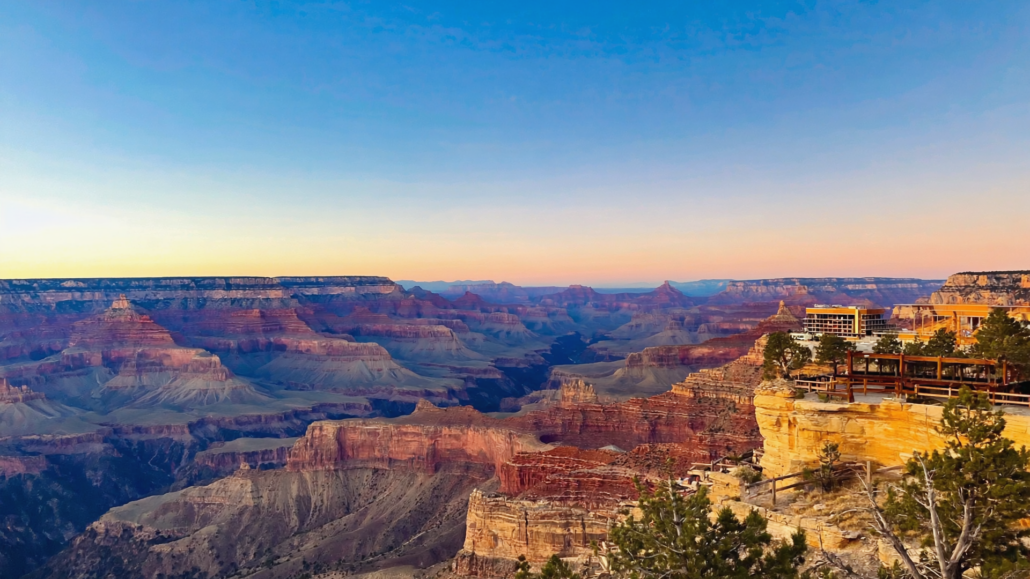
Grand Canyon Accommodation Compared: Tusayan Hotels vs. In-Park Lodges vs. Flagstaff Bases
Most Grand Canyon visitors make their lodging decision the same way: they search “hotels near Grand Canyon South Rim,” see that Bright Angel Lodge is booked solid, and default to whatever Tusayan room is still available. That reactive approach costs more money, adds unnecessary stress, and often lands travelers in the wrong location for how they actually want to experience the canyon.
The honest truth is that where you sleep on a Grand Canyon trip shapes everything else: how early you can reach the rim, how much you spend on transportation, how flexible your itinerary can be, and how rested you feel when you finally stand at the edge. Tusayan hotels, in-park lodges, and Flagstaff base camps each serve a genuinely different traveler. Choosing the wrong one is not just a minor inconvenience, it can define whether your trip feels effortless or exhausting.
This comparison breaks down all three options with the candor they deserve: real trade-offs, honest pricing context, and clear guidance on which type of traveler each option actually suits. No fence-sitting. By the end, you will know exactly which base makes sense for your trip.
Why Your Lodging Choice Is a Trip Strategy Decision
Before comparing options, it helps to understand why this decision carries so much weight. The South Rim of Grand Canyon National Park sits in a remote part of northern Arizona, and the geography of the surrounding area creates real logistical consequences for travelers. There is no urban center nearby. The closest mid-size city is Flagstaff, roughly 80 miles south on US-180 and AZ-64. Tusayan is a small unincorporated community pressed right up against the South Rim entrance gates. And the lodges inside the park sit within Grand Canyon Village, meaning guests wake up with the canyon literally outside their window.
Each of those locations has a dramatically different feel, a different price point, and a different relationship with the park experience itself. Distance from the rim is the defining variable: in-park guests walk to viewpoints in minutes; Tusayan guests drive or shuttle 7–10 minutes; Flagstaff visitors commit to a 90-minute round trip before they ever see the canyon. That gap multiplies across a multi-day trip.
There is also a planning timeline dimension. In-park lodges, operated by Xanterra Travel Collection under a National Park Service concession, book out months in advance, sometimes more than a year for peak summer dates. Tusayan hotels follow normal hotel booking windows. Flagstaff accommodations offer the most flexibility and the widest range of options, from budget chains to boutique properties.
Understanding these structural differences before comparing specific features prevents the most common mistake: evaluating options as if they were interchangeable, when they are actually serving different trip philosophies entirely.
In-Park Lodges: The Rim-Side Experience Most Visitors Dream About
Staying inside Grand Canyon National Park puts you closer to the rim than any other option, but it comes with strict availability constraints and premium pricing that require planning well in advance. For travelers who prioritize immediate canyon access and a fully immersive park experience, in-park lodges are the gold standard. For everyone else, the trade-offs deserve careful scrutiny.
What the In-Park Lodges Actually Offer
Grand Canyon National Park’s South Rim has six lodging properties, all operated by Xanterra Travel Collection. They range from the historic El Tovar Hotel, which opened in 1905 and sits literally on the canyon rim, to the more utilitarian Trailer Village RV Park. The primary options for most leisure travelers are El Tovar, Bright Angel Lodge, Kachina Lodge, Thunderbird Lodge, Maswik Lodge, and Yavapai Lodge.
El Tovar represents the premium end: a National Historic Landmark with full-service dining, a lobby that has hosted presidents, and rooms that book out more than a year ahead for summer dates. Bright Angel Lodge sits directly on the rim and offers a range of room types from basic cabins to rim-facing rooms with canyon views. Kachina and Thunderbird are mid-century motel-style properties that trade charm for reliability. Maswik and Yavapai are further from the rim and offer more accessible pricing, though still at a significant premium compared to comparable rooms elsewhere.
The pricing across these properties reflects the captive-market reality of national park lodging. Rates vary considerably by property and room type, and none of these options would be considered budget travel. The trade-off that justifies the cost is not luxury, it is proximity and atmosphere.
The Real Advantages of Sleeping Inside the Park
The most underrated benefit of in-park lodging is the ability to experience the canyon at hours when most visitors are absent. Sunrise at the South Rim, when the canyon fills with angled golden light and the crowds have not yet arrived, is transformational. In-park guests can walk to Mather Point or Bright Angel trailhead in minutes, before parking lots fill and shuttle buses start running. This kind of spontaneous, unhurried access is simply not available to visitors driving in from Tusayan or Flagstaff.
Sunset viewing follows the same logic. Day visitors scramble to leave before gates get congested. In-park guests can linger at the rim as long as they want and walk back to their room in the dark. For photographers and nature enthusiasts, this flexibility alone justifies the premium.
There is also the practical matter of car-free movement. Once parked inside the park, guests can use the free Grand Canyon South Rim shuttle system to reach all major viewpoints, trailheads, and services without moving their vehicle again. During peak season, when parking inside the park is extremely competitive, this is a significant operational advantage.
The Real Disadvantages: Availability, Pricing, and Amenity Gaps
The disadvantages are substantial and should not be minimized. Booking requires planning six to thirteen months ahead for peak season dates. Cancellation policies are relatively inflexible. Dining options inside the park are limited and priced accordingly. Connectivity is poor, with unreliable cell service and limited Wi-Fi. For families with young children who need predictable mealtimes, entertainment options, and fast-food flexibility, the in-park environment can feel austere.
Room quality at most in-park properties is functional rather than impressive. The lodges are maintained adequately, but they are not luxury accommodations. Travelers accustomed to modern hotel amenities, reliable streaming, updated bathrooms, fitness centers, pools, will find in-park options spartan. You are paying for location, not amenities.
| Feature | In-Park Lodges | Tusayan Hotels | Flagstaff Hotels |
|---|---|---|---|
| Distance to South Rim | Walking distance (0–1 mile) | 7–10 minutes by car/shuttle | 80 miles / ~90 min drive |
| Booking Lead Time Needed | 6–13 months (peak season) | 2–8 weeks (peak season) | Days to weeks |
| Relative Price Point | $$$ – $$$$ | $$ – $$$ | $ – $$$ |
| Dining Options On-Site | ⚠️ Limited, park-operated | ✅ Multiple restaurants in town | ✅ Full city restaurant scene |
| Modern Amenities (Pool, Gym, Wi-Fi) | ❌ Mostly absent | ✅ Available at most properties | ✅ Full amenity range |
| Sunrise/Sunset Canyon Access | ✅ Immediate, on foot | ⚠️ 10-min drive required | ❌ 90-min drive required |
| Flexibility for Last-Minute Trips | ❌ Very low | ⚠️ Moderate | ✅ High |
| Cell Service / Connectivity | ❌ Unreliable | ⚠️ Variable | ✅ City-standard |
| Family-Friendly Services | ⚠️ Limited | ✅ Good variety | ✅ Excellent |
| EV Charging | ⚠️ Limited in-park options | ✅ Available at Grand Canyon Visitor Center IMAX (150kW / 350kW) | ✅ City-standard network |
Who Should Choose In-Park Lodges
In-park lodging is the right call for experience-first travelers who plan well in advance: couples celebrating milestone trips, serious photographers targeting golden-hour light, hikers who want to start the Bright Angel Trail before dawn, and anyone for whom the canyon atmosphere itself is the point. If you have a specific date in mind and can book six months out, the in-park experience is genuinely worth the premium. If you are planning within weeks of your trip, availability will almost certainly close this option.
Tusayan Hotels: The Practical Sweet Spot for Most South Rim Visitors
Tusayan hotels represent the most practical lodging choice for the majority of Grand Canyon South Rim visitors, offering a genuine balance between proximity, availability, amenities, and price. The small community of Tusayan sits just outside the South Rim entrance gates on AZ-64, and its hotel cluster has grown specifically to serve the park’s visitor base. For families, first-timers, and travelers who could not secure in-park reservations, Tusayan delivers a workable solution that does not significantly compromise the canyon experience.
The Tusayan Hotel Landscape
Tusayan is a compact community, essentially a single-street town oriented around the Grand Canyon South Rim entrance. The lodging options include a Best Western Premier, a Grand Hotel, a Holiday Inn Express, and several independent properties. Room quality across these properties is generally solid by highway-corridor standards: clean, reliable, and equipped with the modern amenities (pools, Wi-Fi, breakfast options) that in-park lodges often lack.
Pricing in Tusayan is elevated relative to comparable hotels in other markets, reflecting the captive demand of a tourist gateway. Peak summer rates can rival in-park lodge pricing at the lower end, though off-season visitors find Tusayan considerably more affordable. The key differentiator from in-park lodging is availability: Tusayan hotels, while busy, operate on normal hotel booking windows and are reachable within weeks rather than months of a trip date.
The Distance Question: How Much Does 7 Minutes Actually Matter?
The most common objection to Tusayan lodging is that it requires a short drive into the park each day. In practice, this is less of a burden than it sounds, and more of one than Tusayan boosters tend to admit. The honest answer is: it depends entirely on how you are using your days.
For a standard two-day South Rim itinerary, arrive, walk the Rim Trail, visit viewpoints, maybe take a guided tour, the 7–10 minute drive from Tusayan is genuinely negligible. You park inside the park, use the shuttle system for the rest of the day, and return to Tusayan in the evening. This workflow functions smoothly and causes no meaningful loss of canyon time.
Where the distance starts to matter is for travelers chasing sunrise. The South Rim’s most photographed light happens in the first 30–45 minutes after dawn. Getting from Tusayan into the park, through the entrance, and to a viewpoint adds meaningful transit time to an already early morning. It is doable, but it requires a 4:30–5:00 AM departure that in-park guests can avoid entirely.
Evening access is similarly affected. Tusayan guests who want to watch the sunset and stay for the full post-sunset glow on the canyon walls need to be mindful of the drive back, particularly during peak season when South Rim traffic can back up at the entrance gate. This is not a dealbreaker, but it is a genuine consideration.
Tusayan’s Practical Advantages Beyond the Hotels Themselves
One underappreciated advantage of Tusayan as a base is the concentration of pre-park services in a walkable area. Restaurants, gas stations, small grocery options, ATMs, and tour operators are all clustered along the same stretch. Travelers can fuel up, grab breakfast, and organize their day without entering the park at all.
At the center of this ecosystem sits the Grand Canyon Visitor Center IMAX, located in Tusayan just outside the South Rim entrance. This privately operated facility (not affiliated with or operated by the National Park Service) is a natural first stop for Tusayan-based visitors. Before entering Grand Canyon National Park, travelers can catch the flagship film “Grand Canyon: Rivers of Time” on a six-story IMAX screen using IMAX with Laser technology, pick up National Park entrance passes at the facility, fuel an EV at the on-site Ultra-Fast 150 kW or Hyper-Fast 350 kW chargers, grab a meal at Pizza Hut Express or Explorers Café, and book a Pink Jeep Tour departing directly from the front door.
For first-time visitors especially, experiencing “Grand Canyon: Rivers of Time” before entering the park provides geological and cultural context that dramatically enriches what you see at the rim. It is a meaningful orientation tool, not just a tourist attraction. Book IMAX tickets online and save 20% off the door price, a practical tip worth knowing before you arrive.
The Pink Jeep Tours office on-site deserves specific mention for families and travelers who want a guided experience. Every Pink Jeep Tour originating from Grand Canyon Visitor Center IMAX includes a ticket to “Grand Canyon: Rivers of Time,” making the combination an efficient and well-rounded half-day investment. Pink Jeep is recognized as Best Tour Operator, and having the pickup point steps from your Tusayan hotel removes the logistical friction that guided tours can sometimes create.
Tusayan’s Limitations: Be Honest Before You Book
Tusayan is not a destination in itself. Once the park closes for the evening and you have returned to your hotel, entertainment options are limited. The dining scene, while adequate, is narrow. There is no nightlife, no cultural programming, and very little to do after dark beyond heading back to the hotel. Travelers who value evening variety or a lively atmosphere after a day of hiking will find Tusayan quiet to the point of monotony.
The community’s single-road layout also means that during peak season, traffic on AZ-64 between Tusayan and the park entrance can slow considerably. This does not add massive transit time, but it can be frustrating when you are trying to reach the park for an early morning hike.
Who Should Choose Tusayan Hotels
Tusayan is the right base for families with children, first-time visitors, travelers who could not book in-park lodges, and anyone who wants modern hotel amenities alongside genuine proximity to the South Rim. It is also the logical choice for EV drivers, given the high-power charging infrastructure at Grand Canyon Visitor Center IMAX that is not reliably matched inside the park. Tour group coordinators and travelers booking guided jeep experiences will find the Tusayan infrastructure purpose-built for their needs. This is lodging near Grand Canyon South Rim that genuinely delivers on its proximity promise without the booking-window anxiety of in-park alternatives.
Flagstaff as a Base Camp: The Long-Distance Option That Surprises Travelers
Using Flagstaff as a base for Grand Canyon day trips is a genuinely viable strategy for certain traveler profiles, offering the widest accommodation range, the most dining variety, and the greatest flexibility, at the cost of roughly three hours of daily driving. Most Grand Canyon planning guides dismiss Flagstaff as impractically distant, but this undersells the option for travelers whose priorities extend beyond the canyon itself.
The Flagstaff Advantage: A Real City With Real Options
Flagstaff is a legitimate small city with a population of roughly 75,000, a historic Route 66 downtown, Northern Arizona University, and a thriving outdoor recreation culture. The accommodation range spans budget chain hotels near I-40 to boutique properties in the historic downtown district. Nightly rates, particularly off-peak, are consistently lower than Tusayan for comparable quality, and the selection of dining, grocery, and retail options is incomparably broader.
For travelers combining the Grand Canyon with other Southwest destinations, Flagstaff’s location is genuinely strategic. Sedona is 45 minutes south on US-89A. Monument Valley, Antelope Canyon, and the Navajo Nation are accessible via US-160 northeast of Flagstaff. The city functions as a hub for multi-destination Arizona road trips in a way that Tusayan, hemmed in by the park, simply cannot.
Flagstaff also sits at 7,000 feet of elevation, making it dramatically cooler than Phoenix and notably cooler than the South Rim itself in summer. For families traveling in July and August, Flagstaff nights provide genuine relief from desert heat that neither Tusayan nor the South Rim can offer as consistently.
The Math on the Drive: Honest Assessment
The distance from Flagstaff to the South Rim’s Grand Canyon Village is approximately 80 miles via US-180 north and AZ-64. Under normal traffic conditions, this is a 75–90 minute drive each way. For a two-day canyon visit, that is 3–6 hours of driving across the trip that in-park and Tusayan guests avoid entirely.
That is a meaningful sacrifice. On a single-day Grand Canyon visit, driving from Flagstaff leaves you roughly 8–10 hours at the rim (assuming a reasonable morning departure), which is adequate for most first-time visitor itineraries. On a two-day visit, the math becomes more painful: you are spending a cumulative half-day in the car that could be spent at the rim.
The drive itself is scenic, particularly the stretch through the Kaibab National Forest on AZ-64, and most travelers report it as pleasant rather than punishing. But it is time, and time at the Grand Canyon is the resource visitors have least of.
Flagstaff for Multi-Destination Southwest Road Trips
Where Flagstaff genuinely earns its place as a base is within the context of an extended Southwest road trip. If your itinerary includes Phoenix, Sedona, Grand Canyon, Monument Valley, and possibly Bryce Canyon or Zion, anchoring in Flagstaff for two or three nights and day-tripping to the canyon is a completely rational strategy. It eliminates the need to move accommodations every night, keeps you near a full-service city for resupply and rest, and positions you centrally for the surrounding destinations.
International tourists visiting multiple American Southwest sites in a single trip often find this approach more coherent than chasing the canyon-first, everything-else-after itinerary that domestic visitors more naturally follow. A traveler arriving from overseas with two weeks to cover the American Southwest is often better served by Flagstaff’s hub positioning than by the single-canyon focus that Tusayan enforces.
Flagstaff’s Real Limitations for Canyon-First Travelers
The limitations are stark for anyone whose primary purpose is maximizing South Rim time. Sunrise photography from Flagstaff requires a 3:30–4:00 AM departure, which is not sustainable across multiple days. Spontaneous decisions to stay at the rim for a second sunset, or to start a morning hike at first light, are essentially foreclosed. The canyon experience becomes more scheduled and less immersive when approached as a day trip rather than an overnight stay.
Families with young children may also find the long drives between Flagstaff and the rim exhausting in a way that erodes the enjoyment of both the city and the canyon. A tired six-year-old in the back seat for 90 minutes each way does not improve the visitor experience at either end.
Who Should Choose Flagstaff as a Base
Flagstaff works best for multi-destination road trippers, budget-conscious travelers who need affordable accommodation combined with canyon access, couples who want a lively evening scene alongside a canyon day trip, and international visitors following a broad Southwest itinerary. It is a poor choice for families focused exclusively on the canyon, photographers chasing early light, or anyone who wants more than one full day of immersive rim access.
Comparing the True Cost of Each Option
Price comparisons between these three lodging categories are often misleading because they compare room rates in isolation. A complete cost picture requires factoring in transportation, park entrance fees, dining, and the value of time. The table below presents a realistic framework for a two-adult, two-night South Rim trip across all three options.
| Cost Category | In-Park Lodge | Tusayan Hotel | Flagstaff Hotel |
|---|---|---|---|
| Accommodation (2 nights, relative) | Highest | Mid-range | Lowest to mid-range |
| Transportation to Rim | None (walk) | Minimal (short drive) | Significant (160 miles/day round-trip) |
| Fuel Cost (est. 2-day trip) | Minimal | Low | Adds meaningfully to total trip cost |
| Dining Flexibility | Limited; in-park pricing | Good variety in Tusayan | Excellent; full city range |
| Park Entrance Fee | Required (or America the Beautiful Pass) | Required; purchase at Grand Canyon Visitor Center IMAX in Tusayan | Required (or America the Beautiful Pass) |
| Effective Canyon Time (2 days) | Maximum, sunrise to stars | High, minimal transit friction | Reduced, 3–6 hours lost to driving |
A practical note on park entrance passes: travelers staying in Tusayan can purchase various National Park entrance passes on-site at Grand Canyon Visitor Center IMAX before heading to the South Rim entrance. During peak season, when entrance lines can extend significantly, having your pass ready in advance is a meaningful time-saver. This is a genuine operational advantage of the Tusayan base that is easy to overlook in a room-rate-only comparison.
Seasonal Factors That Change the Calculus
The best lodging base for your Grand Canyon trip is also a function of when you are visiting. The South Rim is open year-round, but visitor patterns, weather, and operational status shift considerably across seasons, and those shifts favor different lodging strategies.
Summer (June–August): Peak Crowds, Peak Heat, Maximum Competition
Summer is the highest-demand period for all three lodging options. In-park lodges book out earliest and hold their rates firmest. Tusayan hotels fill quickly and price accordingly. Flagstaff, counterintuitively, becomes more attractive in summer because its higher elevation makes it meaningfully cooler, and its wider accommodation inventory means last-minute bookings remain possible when Tusayan is sold out.
Summer visitors who have not locked in lodging should prioritize Flagstaff as a backup if neither Tusayan nor in-park options are available. The drive is real, but sleeping in an air-conditioned Flagstaff hotel beats scrambling for an overpriced last-minute room in a nearby town with no canyon proximity at all.
Fall (September–November): The Ideal Season for Every Option
Fall is the South Rim’s best-kept secret. Crowds thin noticeably after Labor Day, temperatures become comfortable for hiking, and canyon light takes on a quality that summer haze often obscures. All three lodging options become easier to book and relatively more affordable in fall. In-park lodges occasionally have last-minute availability that summer forecloses. Tusayan hotels offer genuinely good value. Flagstaff’s fall foliage adds a secondary attraction to what would otherwise be purely a canyon day-trip base.
For couples and solo travelers seeking an off-peak canyon experience, fall timing combined with Tusayan or in-park lodging creates the ideal combination of availability, atmosphere, and value.
Winter (December–February): Flagstaff Becomes the Strategic Choice
Winter at the South Rim is dramatic: snow on the canyon rim, fewer than 10% of the park’s annual visitors, and a stillness that summer visitors never experience. However, winter also brings operational considerations. Some in-park services and seasonal facilities reduce hours or close entirely. Road conditions between Flagstaff and the rim can be affected by snowfall, though AZ-64 is maintained and typically passable.
In winter, Flagstaff’s infrastructure advantage becomes more pronounced. The city’s full-service dining, entertainment, and accommodation options provide a reliable base when in-park services are reduced. Tusayan remains a solid option for winter visitors who want maximum rim proximity, and the Grand Canyon Visitor Center IMAX operates year-round, a meaningful advantage when winter weather makes extended outdoor time less predictable.
Spring (March–May): The Sleeper Season
Spring, particularly late April and May, rivals fall for visitor experience quality. Wildflowers appear along the rim and in the canyon, temperatures are moderate, and crowds remain below summer peaks until Memorial Day. All three lodging options perform well in spring. In-park lodges may have availability with two to three months of lead time rather than requiring six-plus months. Tusayan pricing is reasonable. Flagstaff offers pleasant shoulder-season rates with increasingly warm evenings.
The Decision Framework: Matching Your Trip Profile to the Right Base
Rather than presenting a single universal recommendation, the most useful guidance acknowledges that these three options serve genuinely different traveler profiles. The matrix below maps common trip scenarios to the most appropriate base.
| Your Situation | Best Base | Why |
|---|---|---|
| Booked 6+ months out, experience-focused, no children | In-Park Lodge | Maximum rim access, sunrise/sunset flexibility, full immersion |
| Family with young children, first-time visitors | Tusayan Hotel | Modern amenities, dining variety, proximity without in-park booking stress |
| Multi-destination Southwest road trip | Flagstaff | Hub positioning, city amenities, lower cost base for multi-stop itinerary |
| Photography-focused, sunrise/sunset priority | In-Park Lodge (preferred) or Tusayan | Early access essential; Tusayan workable with 4:30 AM departures |
| Budget traveler, flexible timing | Flagstaff (off-peak) or Tusayan | Flagstaff offers lowest rates; Tusayan wins on proximity-to-cost ratio at peak |
| EV driver, road tripper needing fast charging | Tusayan | Ultra-Fast 150 kW / Hyper-Fast 350 kW chargers at Grand Canyon Visitor Center IMAX |
| Guided tour booked (Pink Jeep, etc.) | Tusayan | Pink Jeep Tours departs from Grand Canyon Visitor Center IMAX front door |
| Last-minute booking, peak season | Flagstaff (widest availability) | Larger inventory; Tusayan sells out, in-park is inaccessible last-minute |
| Winter visit, weather-conscious | Tusayan or Flagstaff | Both offer year-round infrastructure; Flagstaff has city services for winter contingencies |
The Honest Recommendation: What Most Travelers Should Actually Do
After working through all three options in detail, the honest recommendation for most Grand Canyon South Rim visitors is this: if you can book in-park, do it. If you cannot, Tusayan is the correct default. Flagstaff is a strategic choice for specific trip profiles, not a compromise.
In-park lodging wins on the experience dimension without qualification. The ability to be at the rim at sunrise, to stay for the full post-sunset afterglow, to walk the Rim Trail at 10 PM under a sky of stars, these are not trivial enhancements. They are genuinely different experiences from what Tusayan or Flagstaff can provide. If your trip is built around the Grand Canyon specifically and you are planning more than a few months out, pursue in-park reservations first and commit the booking the day the availability window opens.
When in-park lodging is not available, which is most of the time for most travelers, Tusayan is the correct answer for the vast majority of South Rim visitors. The proximity is genuine, the amenity gap relative to in-park lodges is favorable to Tusayan, the dining and service infrastructure is solid, and the pre-park-entry ecosystem (including Grand Canyon Visitor Center IMAX with its IMAX theater, Pink Jeep Tours, dining, park passes, and EV charging) makes Tusayan a fully functional trip base rather than just a sleeping arrangement. Start your Grand Canyon adventure with IMAX before you even reach the South Rim gates, and you will arrive at the canyon rim with geological context and cultural perspective that makes every viewpoint more meaningful.
Flagstaff earns a genuine recommendation for road trippers covering multiple Southwest destinations, budget travelers in off-peak seasons, and visitors for whom the canyon is one item on a broader Arizona itinerary. It is not a consolation prize. For those specific profiles, it is the most rational choice. But it should be chosen for its own strengths, not selected by default.
One final note on the hybrid strategy that experienced Southwest travelers often use: book Tusayan for the bulk of your canyon nights, but consider a single Flagstaff night at the beginning or end of your trip to access city services, grocery stores, and a wider restaurant scene. This combination captures the proximity benefits of Tusayan without completely forgoing the quality-of-life advantages that a real city provides. It is a small logistical complication that pays meaningful dividends across a week-long Southwest trip.
Frequently Asked Questions About Grand Canyon South Rim Lodging
How far is Tusayan from the Grand Canyon South Rim entrance?
Tusayan sits approximately 7 miles south of the South Rim entrance station on AZ-64. In normal traffic conditions, the drive takes under 10 minutes. During peak summer season, entrance gate congestion can extend this slightly, particularly in the mid-morning hours when day visitors arrive in volume.
Can I buy Grand Canyon entrance passes before reaching the park gate?
Yes. Grand Canyon Visitor Center IMAX in Tusayan sells various National Park entrance passes on-site, including annual passes such as the America the Beautiful Interagency Pass. Purchasing your pass before reaching the entrance gate is a practical time-saver, especially during peak season when gate lines can be long. This is one of the meaningful logistical advantages of stopping in Tusayan before entering the park.
How far in advance do I need to book in-park Grand Canyon lodging?
For peak summer dates (June through August), in-park reservations through Xanterra Travel Collection typically require booking six to thirteen months in advance. El Tovar and Bright Angel Lodge rim-view rooms sell out fastest. Shoulder season (April–May, September–October) requires less lead time but still benefits from booking two to four months out. Winter availability is generally more accessible.
Are Tusayan hotels worth the cost compared to staying in Flagstaff?
For visitors whose primary purpose is the South Rim, yes. The proximity premium in Tusayan is genuine: you save 3–6 hours of driving across a two-day trip and gain meaningful flexibility for early morning and evening rim access. For multi-destination road trippers or budget travelers whose canyon visit is one day in a broader itinerary, Flagstaff’s lower rates and wider accommodation inventory may tip the balance.
Does Grand Canyon Visitor Center IMAX charge a separate admission fee from the park?
Yes. Grand Canyon Visitor Center IMAX is a privately operated facility located in Tusayan, outside Grand Canyon National Park. It is not affiliated with the National Park Service. The IMAX theater charges a separate admission fee for “Grand Canyon: Rivers of Time.” Booking IMAX tickets online saves 20% compared to door pricing. The facility’s services, including EV charging, dining, and Pink Jeep Tours, are available independently of park entrance.
Is Flagstaff a good base for Grand Canyon day trips?
Flagstaff works well as a Grand Canyon day-trip base for travelers who are also visiting Sedona, Monument Valley, or other northern Arizona destinations, and for those who need the broader accommodation and dining range of a real city. The 80-mile, roughly 90-minute drive each way is manageable for one or two days, but becomes tiring if repeated across a longer itinerary focused solely on the canyon.
What are the best lodging options for families with young children visiting the South Rim?
Tusayan hotels are generally the best fit for families with young children. They offer pools, reliable Wi-Fi, multiple dining options including familiar chains, and the proximity to the rim that keeps transit friction low. The Grand Canyon Visitor Center IMAX also provides a child-friendly orientation experience before entering the park, and Pink Jeep Tours departing from the facility are well-suited to families who want a guided experience without the logistics of self-guided hiking.
Can I use the Grand Canyon free shuttle system if I am staying in Tusayan?
The free National Park Service shuttle system operates within Grand Canyon National Park and connects viewpoints, trailheads, and services inside the park. There is also a Tusayan shuttle (the Greenway bus) that provides service between Tusayan and the South Rim Visitor Center area during peak season, allowing Tusayan-based guests to reach the park without driving during high-traffic periods. Check current NPS shuttle schedules before your trip as seasonal availability varies. You can also read more about navigating the Grand Canyon Tusayan shuttle for practical tips on using this service.
What is the difference between the Grand Canyon Visitor Center IMAX and the official NPS Visitor Center?
These are two distinct facilities. Grand Canyon Visitor Center IMAX is a privately operated facility in Tusayan, just outside the South Rim entrance gates, featuring an IMAX theater, Pink Jeep Tours, dining, retail, and EV charging. The official NPS Grand Canyon Visitor Center is inside the park at Grand Canyon Village and is operated by the National Park Service. Both serve planning and orientation functions, but they operate independently and offer different services. The Grand Canyon Visitor Center IMAX is the logical first stop before entering the park; the NPS Visitor Center is typically reached after you have entered.
What is the best time of year to visit the South Rim for lodging availability?
Fall (September through November) and spring (March through May) offer the best combination of lodging availability, reasonable pricing, and comfortable weather for South Rim visits. Summer delivers the widest range of operational park services but the highest competition for rooms across all three lodging categories. Winter offers the most available rooms and the most dramatic canyon atmosphere, though some park services operate on reduced schedules.
Are there EV charging stations near the Grand Canyon South Rim?
Grand Canyon Visitor Center IMAX in Tusayan has Ultra-Fast 150 kW and Hyper-Fast 350 kW EV chargers on-site, making it one of the most capable EV charging locations in the immediate South Rim vicinity. EV drivers on Southwest road trips will find this a practical stop regardless of whether they plan to visit the IMAX theater. In-park EV charging options are more limited, making Tusayan the stronger base for EV-dependent travelers.
What guided tours are available for travelers staying in Tusayan?
Pink Jeep Tours operates out of Grand Canyon Visitor Center IMAX in Tusayan, with tours departing directly from the front door. Every Pink Jeep Tour originating from the facility includes a ticket to “Grand Canyon: Rivers of Time,” making it a combined IMAX-plus-jeep-tour package. Pink Jeep is recognized as Best Tour Operator and offers a range of guided experiences suited to different group sizes and interests, from rim-view tours to more adventurous off-road options. For adventure travelers and families who want a guided introduction to the canyon, this combination is one of the most efficient ways to organize the first day of a South Rim visit.
Key Takeaways for Grand Canyon Overnight Accommodations
- In-park lodges deliver the best canyon experience but require 6–13 months of advance booking for peak dates and come at the highest price point with the fewest modern amenities.
- Tusayan hotels are the right default for most visitors: genuine proximity to the South Rim, modern amenities, better dining variety, and a manageable booking window. They are the strongest practical choice for families, first-timers, and guided tour travelers.
- Flagstaff as a base makes strategic sense for multi-destination road trippers, budget travelers in off-peak seasons, and visitors for whom the canyon is part of a broader Southwest itinerary rather than the sole destination.
- The Grand Canyon Visitor Center IMAX in Tusayan anchors the pre-park-entry experience with the “Grand Canyon: Rivers of Time” IMAX film, Pink Jeep Tour departures, National Park pass sales, on-site dining, and high-speed EV charging. Stopping here before entering the park is the single most useful habit Tusayan-based travelers can develop.
- Book IMAX tickets online in advance to save 20% and secure your preferred showtime, particularly useful during summer when the facility is operating at peak capacity.
- Season matters as much as location: fall and spring offer the best combination of availability, pricing, and experience quality across all three lodging categories.
- The hybrid strategy of Tusayan nights combined with a Flagstaff night for city services is a practical approach for week-long Southwest road trips that captures the best of both options.
- Whatever your base, securing your National Park entrance pass before reaching the gate (available at Grand Canyon Visitor Center IMAX) saves meaningful time during peak season.

About the author
Explore The Canyon Editorial Team
See The Canyon
Learn more →

