
Grand Canyon for Kids: 10 Educational Stops, Activities, and IMAX Experiences That Make Learning Stick
Most kids forget a museum within a week. Ask them about the Grand Canyon five years later, and they’ll still be talking about it. That’s not an accident, it’s the result of how the canyon teaches. Unlike a classroom exhibit behind glass, the Grand Canyon puts geology, ecology, Indigenous history, and raw planetary scale directly in front of a child’s face and dares them to process it. The challenge for parents and educators isn’t whether the canyon can educate kids. It’s knowing which stops, in which order, with which context, actually make the learning stick.
This guide is built around that challenge. The ten stops and experiences below are ranked by educational impact, not by popularity or ease of access. Each one targets a different learning style, a different subject area, and a different age group. Together, they form a complete Grand Canyon educational itinerary that transforms a family sightseeing trip into something kids genuinely retain. Start before you even reach the park gates, because the first stop on this list is also the most underused orientation tool available to South Rim visitors.
1. Grand Canyon IMAX Theater: The Orientation That Changes How Kids See Everything Else
Before entering Grand Canyon National Park, stop at the Grand Canyon Visitor Center IMAX in Tusayan. Watching “Grand Canyon: Rivers of Time” on a six-story screen using IMAX with Laser technology gives children a visual and geological framework that makes every subsequent rim-side moment more meaningful. Without this context, most kids look at the canyon and see a very big hole. With it, they see 1.8 billion years of Earth’s story.
Located in Tusayan just outside the South Rim entrance gates, the Grand Canyon Visitor Center IMAX is privately operated and distinct from the official NPS Visitor Center inside the park at Grand Canyon Village. That distinction matters practically: you can stop here before purchasing your park pass (passes are sold on-site, saving time at the gate), grab a meal at Pizza Hut Express or Explorers Café, and pick up any hiking gear you forgot to pack, all before the park entrance.
The film itself runs approximately 34 minutes and covers the canyon’s geological formation, the Colorado River’s sculpting role, the Indigenous peoples who have called the region home for thousands of years, and the ecological diversity packed into its vertical mile of depth. For children between roughly 6 and 14, this is the ideal entry point. The IMAX with Laser format delivers clarity and scale that no standard-screen presentation can match, when the camera sweeps across the Redwall Limestone cliffs or drops into the Inner Gorge, kids physically react. That visceral response is the first step toward genuine learning.
Why it ranks first: Cognitive science consistently supports the idea that prior knowledge dramatically improves comprehension of new experiences. A child who watches the IMAX film first arrives at Mather Point knowing what the Kaibab Limestone layer is, why the river runs rust-red, and what lived here before humans. That child asks better questions, notices more details, and retains more of what they see. Parents routinely report that their children referenced the film repeatedly throughout their rim visit.
How to apply this: Book IMAX tickets online in advance, you’ll save 20% versus the gate price, and you can time your screening to arrive at the rim during mid-morning light rather than the congested early rush. If you’re booking a Pink Jeep Tour departing from the Grand Canyon Visitor Center IMAX, your tour package already includes a Rivers of Time ticket, so you get the film and a guided canyon experience in one booking. For school groups and educational travel organizers, this combination is particularly efficient, one pre-park stop covers both orientation and active learning.
2. Mather Point: Teaching Scale Through Silence
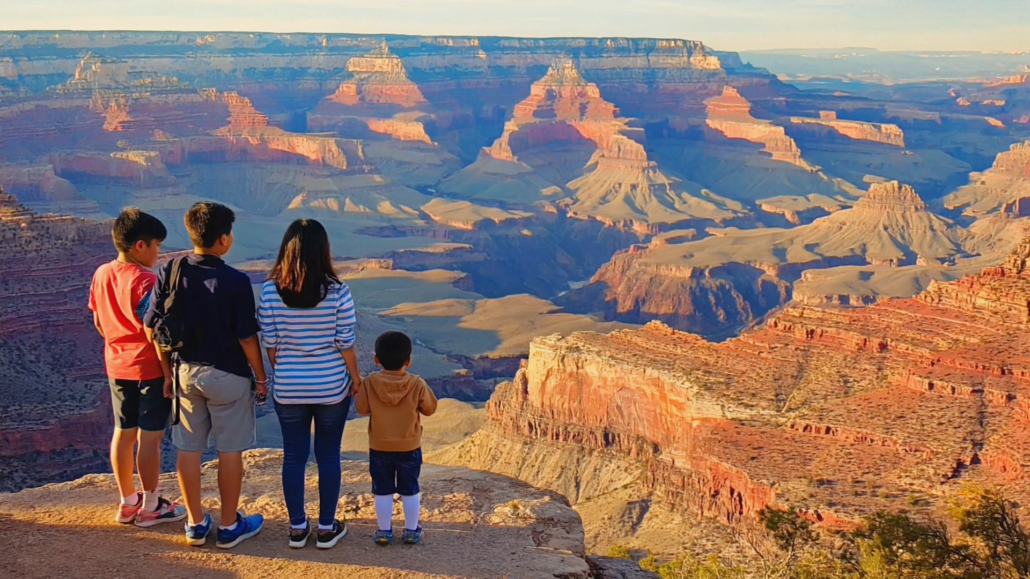
Mather Point, the first major overlook accessible from the South Rim Visitor Center area, is where the canyon’s scale becomes emotionally real for children. It is one of the most visited spots in the park, but that popularity doesn’t diminish its educational value, it amplifies it, because you can watch dozens of people have the same involuntary reaction to the view, which itself becomes a teaching moment about human perception and the limits of our senses.
The canyon at Mather Point is approximately 10 miles wide and drops about a mile to the Colorado River below. Children instinctively try to locate the river and frequently can’t, it’s often obscured by the Inner Gorge’s walls. That frustration is pedagogically useful. Ask your kids to estimate how far away the North Rim is. Their guesses are almost always off by a factor of two or three. Then reveal the actual distance. That gap between perception and reality opens a natural conversation about scale, about why human brains struggle to process geological distances, and about what it means for something to be truly vast.
The colored layers visible from Mather Point are the canyon’s most legible geological feature. Even young children can count the distinct bands of rock without any technical vocabulary. Start simple: “Each of those stripes is a different kind of rock, and each one took millions of years to form.” Point out the pale Kaibab Limestone at the top (where visitors stand), the reddish Hermit Shale below it, the Coconino Sandstone’s creamy cliff face, and the darker Redwall Limestone further down. The NPS Grand Canyon geology page has printable layer guides that work well as a rim-side reference.
How to apply this: Bring a pair of binoculars for each child old enough to use them. The experience of locating a distant butte, focusing on it, and suddenly seeing its layered detail is memorable in a way that simply looking at the panorama is not. Assign each child a different named butte or temple visible from Mather Point and have them report back what they observe. Wotan’s Throne, Vishnu Temple, and Brahma Temple are visible on clear days and their names alone prompt questions about why a geological formation in Arizona carries a name from Hindu mythology, a thread that leads naturally into the park’s surveying history.
3. Junior Ranger Program: The Single Most Effective Educational Structure at the Park
The Grand Canyon Junior Ranger Program, administered free by the National Park Service, is the most structured and proven educational experience available to children visiting the South Rim. Children complete an age-appropriate activity booklet, participate in at least one ranger-led program, and are then sworn in as official Junior Rangers by an NPS ranger, receiving a badge and a certificate.
What makes this program genuinely effective rather than just a keepsake exercise is the booklet’s design. It’s tiered by age (roughly ages 4–5, 6–8, 9–12, and 13+), so the questions and activities scale appropriately. Younger children complete drawing and matching activities tied to canyon wildlife and geology. Older children are asked to observe specific features at designated overlooks, read interpretive signs critically, and write short reflective responses. Teenagers encounter questions about canyon management, resource protection, and the tension between visitor access and ecological preservation, topics with genuine complexity.
The ranger swearing-in ceremony is not a formality. Children take it seriously, and that seriousness produces a sense of ownership over the park that persists long after the visit. Many families report that their children display their Junior Ranger badges for years and request return visits to “check on” their canyon. That emotional investment is a foundation for environmental stewardship that no classroom lesson can reliably produce.
How to apply this: Pick up the booklet at the South Rim Visitor Center inside the park as soon as you enter Grand Canyon Village. The booklet specifies which ranger programs count toward completion, check the daily schedule posted at the Visitor Center and plan your rim walk around program times. Programs run year-round, though scheduling varies seasonally. Allow at least one full day to complete the booklet properly; families who rush it miss the point. If you have children of different ages, get age-appropriate booklets for each, the conversations between siblings working at different levels are themselves educational.
4. Yavapai Geology Museum: Where the Layers Get Names and Meaning
The Yavapai Geology Museum, perched on Yavapai Point along the South Rim, is the most focused geological learning resource in the park and one of the genuinely underappreciated stops for families with school-age children. The museum’s panoramic windows frame the canyon in a way that lets visitors directly connect what they see outside with the interpretive displays inside, a physical alignment of explanation and evidence that few science museums can replicate.
The centerpiece is a relief map of the canyon that children can study from above, tracing the Colorado River’s path through the gorge and understanding for the first time why the river carved in the specific direction it did. Surrounding displays explain each major rock layer by name, age, and depositional environment. Children learn that the Redwall Limestone formed in a shallow tropical sea, that the Coconino Sandstone preserves ancient dune patterns from a desert that predates the dinosaurs, and that the Vishnu Schist at the canyon’s base is among the oldest exposed rock on Earth’s surface.
For older children and teenagers, the Yavapai Museum introduces the concept of unconformities, gaps in the geological record where entire eras of rock are simply missing. The Great Unconformity at the Grand Canyon, where Cambrian-age rock sits directly atop Precambrian basement rock with roughly 250 million years of geological time unrepresented, is one of the most studied geological phenomena in North America. Presenting this to a curious 12-year-old and asking them why those layers might be missing produces the kind of scientific thinking that standard curricula rarely achieve.
How to apply this: Visit in the early morning or late afternoon, when crowds are lighter and kids can take time with the displays rather than feeling rushed. The museum is free with park admission. Before your visit, read a basic introduction to the canyon’s geology so you can answer follow-up questions confidently, the NPS geology page linked above is a good primer. Pair the Yavapai visit with a stop at Mather Point using binoculars: send kids back outside after the museum to find specific formations they just read about inside.
5. Ranger-Led Programs at the Rim: Live Science in the Field
NPS ranger-led programs at the South Rim are scheduled daily and cover topics ranging from geology to wildlife to canyon history, making them the closest equivalent to a live classroom that any outdoor setting can offer. Ranger programs are free with park entry, typically run 30–60 minutes, and are designed to be accessible to mixed-age audiences.
What distinguishes a ranger-led program from reading an interpretive sign is the live interaction. Rangers answer children’s questions in real time, adjust their explanations based on what the audience already knows, and demonstrate concepts with props, specimens, and direct observation. A child who asks a ranger “why is the river that color?” and receives a full explanation of suspended sediment, erosion rates, and seasonal flow patterns has learned more in three minutes than they would from an hour of reading.
Common program topics at the South Rim include: fossil identification (the Kaibab Limestone near the rim contains marine fossils, which children find astonishing), condor biology (California condors are a conservation success story visible from the rim), fire ecology, and the human history of the canyon from the earliest Indigenous inhabitants through the Fred Harvey era. Each topic connects to a different school subject, biology, chemistry, history, environmental science.
How to apply this: Check the NPS Grand Canyon ranger programs schedule before your trip and again on the morning of your visit (schedules update seasonally). Programs fill quickly in summer; arrive 10–15 minutes early. If you have a specific subject you’d like to emphasize, geology for a science class trip, Indigenous history for a social studies group, ask the Visitor Center staff which ranger is leading the most relevant program that day. Rangers are knowledgeable beyond their scheduled topics and often happy to recommend the best program match for your group’s interests.
6. Bright Angel Trail’s First Mile: Geology You Can Touch
Walking the first mile of Bright Angel Trail with children provides a hands-on geological education that no museum can match, you physically descend through millions of years of Earth history with each step down the switchbacks. The trail drops approximately 1,120 feet in its first 1.5 miles, passing through multiple distinct rock layers that are visible, touchable, and dramatically different in color and texture.
The upper portion of the trail cuts through Kaibab Limestone and Toroweap Formation, both pale, rough, and fossil-rich. Children who know what to look for can find crinoid stems, brachiopod shells, and coral impressions pressed into the rock face right along the trail edge. These are marine organisms that lived in a shallow sea covering what is now Arizona roughly 270 million years ago. Holding a piece of trail-edge rock and understanding that it was once an ocean floor is a concept that rewires a child’s sense of geological time in a way that diagrams cannot.
Further down, the Redwall Limestone appears in dramatic contrast, steep, reddish cliffs that are actually grey limestone stained by iron oxide washing down from the Hermit Shale above. This is a wonderful lesson in how things are often not what they appear, and why scientists investigate rather than assume. The visual impact of the color change is striking enough that children notice it without prompting, which makes the explanation land harder.
Safety note and planning guidance: The NPS recommends that day hikers on Bright Angel Trail not attempt to hike to the river and back in a single day. For families with children, the first mile to the 1.5-Mile Resthouse (when the resthouse is open) is the appropriate target, it offers shade, emergency water (seasonal), and a turnaround point that doesn’t overextend young hikers. Start early, bring more water than you think you need, and wear sun protection. The trail descends into increasing heat as you go down, and the return climb is significantly harder than the descent.
How to apply this: Print or download a simplified geological cross-section of the canyon before your hike and give each child a copy. As you descend, check off each layer as you pass through it. This transforms the hike from physical exercise into a scavenger hunt with geological objectives, keeping kids engaged and focused on observation rather than fatigue. For families interested in a guided version of this experience, Pink Jeep Tours departing from the Grand Canyon Visitor Center IMAX offer guided canyon tours that include geological interpretation by knowledgeable guides, without the physical demands of the trail descent.
7. Desert View Watchtower: Indigenous History at the Canyon’s Edge
The Desert View Watchtower at the eastern end of the South Rim’s Desert View Drive is one of the most culturally significant stops for children interested in the human history of the Grand Canyon, and one of the most visually dramatic structures in the American Southwest. The 70-foot stone tower was designed by architect Mary Colter and completed in 1932, drawing on the architectural traditions of ancestral Puebloan towers found throughout the Four Corners region.
Inside the watchtower, the walls and ceiling are covered with murals painted by Hopi artist Fred Kabotie, depicting ceremonial scenes, migration stories, and elements of Hopi cosmology. For children, this is often their first encounter with Indigenous art as living cultural expression rather than historical artifact. Kabotie’s murals are not decorative, they encode knowledge, narrative, and belief in visual form, and understanding that distinction changes how children approach all cultural art going forward.
The tower itself is an exercise in architectural ingenuity. Colter incorporated genuine ancient masonry into the structure alongside her own construction, and the interior staircase winds past kiva-style rooms that reference ancestral Puebloan ceremonial spaces. Children who have learned about the canyon’s geological age at Yavapai and Mather Point now encounter the human timeline layered on top of it, people have lived at and around the Grand Canyon for at least 4,000 years, with evidence of human presence dating back considerably further.
The view from the top of the watchtower is the widest panorama available from any South Rim structure, extending to the Colorado River’s bend at Desert View and across to the Painted Desert on clear days. This visual reward motivates children to climb all five levels, and the gradual reveal of the canyon from each successive window is itself a lesson in perspective and elevation.
How to apply this: Before visiting, introduce children to the concept of ancestral Puebloan culture, the people who built cliff dwellings at Mesa Verde and pueblos throughout the Southwest. The NPS provides cultural history resources for Grand Canyon that cover Indigenous peoples’ connections to the canyon across multiple tribes, not only the Hopi. Ask children at the watchtower to identify differences between Colter’s constructed sections and the genuine ancient masonry she incorporated, it’s a more nuanced observation than most adults attempt, and kids frequently surprise their parents.
8. Condor Viewing: A Conservation Story That Kids Actually Care About
Spotting a California condor soaring above the Grand Canyon is one of the most emotionally powerful wildlife encounters available in the American national park system, and the condor’s story is one of the most compelling conservation narratives a child can encounter. With a wingspan reaching up to 9.5 feet, condors are the largest flying birds in North America, and they were functionally extinct in the wild by 1987 when the last 27 individuals were captured for a captive breeding program.
Today, thanks to a sustained recovery effort coordinated by the U.S. Fish and Wildlife Service and multiple conservation partners, more than 300 condors fly free in the wild, with the Grand Canyon region supporting one of the largest wild populations. Birds are tagged with numbered wing tags that visitors with binoculars can read, and many individual birds are known by name and biography to regular canyon observers.
For children, this story hits differently than abstract conservation messaging. The condor was nearly gone. People chose to intervene. The intervention worked. Birds that exist right now, soaring above the rim in front of a child’s eyes, are alive because of deliberate human decisions made over decades. That is a concrete, evidence-based argument for conservation action that no textbook passage can replicate.
Condors are most reliably spotted along the South Rim at overlooks between Mather Point and Yaki Point, particularly in morning hours when thermal activity lifts them above the rim edge. They are also regularly seen near Desert View. Rangers who spot condors often call out wing-tag numbers over radio, and nearby visitors can report sightings to help track individual birds’ movements.
How to apply this: Download the NPS condor information page and bring a printed wing-tag reference sheet if you can find one through local birding groups. Assign children the job of reading wing-tag numbers through binoculars, this gives them a focused task and makes the spotting feel like scientific fieldwork. After your visit, look up the individual bird’s history through condor monitoring databases; knowing that you saw condor #318, a male hatched in captivity and released in a specific year, turns a wildlife sighting into a personal connection.
9. Hermit’s Rest and the Rim Trail Walk: Ecology on Foot
The Rim Trail between Mather Point and Hermit’s Rest stretches approximately 13 miles along the South Rim and is paved, flat, and accessible for most of its length, making it the ideal route for combining ecological observation with physical exploration for families with children of any age. The western sections accessible by the park’s free shuttle system allow families to ride to a distant point and walk back at their own pace, choosing how much distance to cover.
The Rim Trail passes through the Pinyon-Juniper woodland ecosystem that dominates the South Rim’s elevation (approximately 7,000 feet). This ecosystem is distinct from anything most American families encounter at home: gnarled juniper trees with shredding bark adapted to freeze-thaw cycles, single-leaf pinyon pines producing edible seeds that have sustained Indigenous peoples for millennia, Gambel’s oak providing autumn color, and mule deer that have become comfortable enough with human presence to graze within feet of the trail.
Each stop along the route, Trailview Overlook, Maricopa Point, Powell Point, Hopi Point, Mohave Point, The Abyss, Pima Point, offers a different canyon perspective. Hopi Point is widely considered one of the best sunset viewing locations on the South Rim, with an unobstructed western exposure that reveals the Colorado River from multiple angles as the light changes. Powell Point features a memorial to explorer John Wesley Powell, whose 1869 river expedition through the canyon was one of the most remarkable feats of American exploration, a story that resonates with children in the same way that stories of space exploration do.
How to apply this: Rather than treating the Rim Trail as a point-to-point walk, use the free shuttle system strategically. Ride to Hermit’s Rest (the western terminus), then walk back eastward, stopping at overlooks in the order that catches afternoon light most dramatically. This direction also means you’re walking with the crowd flow rather than against it. Assign younger children the job of ecosystem observation, they can count juniper trees, look for animal tracks in sandy soil sections, and collect (with a ranger’s guidance on what’s permitted) pine cones from fallen branches. The Tusayan shuttle is also worth knowing about as a way to access the park without parking stress, particularly during peak season.
10. Pink Jeep Tours: Guided Learning for Kids Who Need to Move
For children who learn through movement, narrative, and direct engagement rather than observation, a guided Pink Jeep Tour departing from the Grand Canyon Visitor Center IMAX is the most effective educational format available near the South Rim. Pink Jeep Tours, recognized as Best Tour Operator, runs guided tours that combine geological interpretation, canyon history, and active exploration in a format specifically suited to children who find static overlooks less engaging.
Every Pink Jeep Tour originating from the Grand Canyon Visitor Center IMAX includes a ticket to “Grand Canyon: Rivers of Time”, meaning families who book a guided tour get the IMAX orientation film as part of their experience. This pairing is pedagogically powerful: children watch the geological and cultural overview on a six-story IMAX screen, then immediately go into the field with a guide who can connect what they saw on screen to what they’re seeing in person. The film provides the conceptual framework; the tour provides the experiential application.
Pink Jeep guides are trained interpreters who adjust their explanations to audience age and interest level. A group of 8-year-olds gets the canyon’s story told through accessible analogies and hands-on stops. A group of teenagers gets more geological and historical depth. The open-air format means kids are physically in the landscape rather than behind glass, and the jeep’s ability to access viewpoints beyond the main road means guides can offer perspectives that rim-walking visitors never see.
The tours depart directly from the front door of the Grand Canyon Visitor Center IMAX in Tusayan, which means families don’t need to navigate park parking, shuttle timing, or in-park logistics before their tour begins. For first-time visitors or families with young children who might find park navigation stressful, this simplicity is a meaningful practical advantage.
How to apply this: Book Pink Jeep Tours in advance, particularly during summer months when availability fills quickly. When booking, mention the ages and interests of the children in your group, guides use this information to prepare their interpretation approach. If your children have specific questions after watching the IMAX film (which they often do), write them down and bring them to the guide at the start of the tour. Guides genuinely enjoy fielding curious kids’ questions, and a child who arrives with a specific geological question and receives a thoughtful answer in the field is a child who will remember that tour for years.
Building Your Educational Grand Canyon Itinerary: A Practical Framework
The ten stops above work best when sequenced intentionally. Below is a framework for combining them across a two-day South Rim visit, organized by educational theme and practical logistics.
| Time Block | Stop / Activity | Primary Learning Theme | Best Age Range | Cost |
|---|---|---|---|---|
| Day 1 Morning | Grand Canyon IMAX Theater (Rivers of Time) | Geological & cultural overview | 5+ | Book online to save 20% |
| Day 1 Morning | Mather Point (first rim view) | Scale & perception | All ages | Park admission |
| Day 1 Midday | Junior Ranger booklet + Visitor Center | Structured inquiry across all subjects | 4–12 | Free with park admission |
| Day 1 Afternoon | Yavapai Geology Museum | Deep geology / rock layers | 8+ | Free with park admission |
| Day 1 Late Afternoon | Ranger-led program | Live science / Q&A learning | All ages | Free with park admission |
| Day 2 Early Morning | Bright Angel Trail (first mile) | Hands-on geology / physical science | 6+ | Park admission |
| Day 2 Morning | Condor viewing (Mather to Yaki Point) | Wildlife / conservation biology | All ages | Park admission |
| Day 2 Midday | Pink Jeep Tour (with IMAX) | Applied geology & guided interpretation | 5+ | Tour package (includes IMAX) |
| Day 2 Afternoon | Desert View Watchtower | Indigenous history & culture | 7+ | Park admission |
| Day 2 Late Afternoon | Rim Trail (Hopi Point sunset) | Ecology / natural systems / reflection | All ages | Park admission |
Park passes are available for purchase at the Grand Canyon Visitor Center IMAX in Tusayan before you reach the entrance gates, a time-saver that pays off significantly during peak summer mornings when gate queues can be lengthy. The facility also offers EV charging (Ultra-Fast 150 kW and Hyper-Fast 350 kW) if you’re road-tripping in an electric vehicle, and on-site dining at Pizza Hut Express and Explorers Café means you can fuel up before a full day at the rim.
What Makes Grand Canyon Learning Different from Any Other Park
Most natural parks offer a version of the same educational experience: a visitor center with interpretive displays, a few ranger talks, some wildlife if you’re lucky, and a scenic backdrop that’s beautiful but not inherently instructive. The Grand Canyon operates differently, and it’s worth understanding why, because that difference shapes how you plan an educational visit.
The canyon is its own textbook. Every rock layer is labeled by time. Every ecological zone from rim to river corresponds to a latitude band from Canada to Mexico. Every Indigenous story connects to a specific geographic feature. The Grand Canyon doesn’t require interpretive infrastructure to be educational in the way that, say, a historical battlefield does. The education is embedded in the geology itself, and almost any question a child asks, “why is that rock red?”, “how deep is it?”, “what lives down there?”, “who lived here first?”, has an answer visible from where they’re standing.
This quality rewards curiosity-driven exploration more than structured touring. Families who follow their children’s questions, stopping when something catches a child’s eye and spending longer at the spots that generate genuine interest, consistently report more memorable visits than those who check off every major viewpoint on schedule. The itinerary above is a framework, not a script. Use it to ensure you hit each learning domain, but let your children’s curiosity determine the pace.
The canyon also teaches patience and observation in a way that modern life rarely demands. Sitting at a rim overlook for 20 minutes without a screen or a structured activity, watching shadows move across buttes and light change on limestone, is itself an educational experience, one that develops attention span, comfort with silence, and the capacity to notice gradual change. These are skills that transfer far beyond a Grand Canyon visit, and they’re skills that many children rarely practice.
For families visiting with children at different developmental stages, the Grand Canyon’s layered complexity means there is genuinely no age at which a child has “finished” learning what the canyon has to offer. A child who visits at 6 will have a completely different experience revisiting at 12, and again at 16. The canyon grows with its visitors in a way that few educational destinations can claim.
Frequently Asked Questions: Grand Canyon for Kids
What is the best age for a child’s first Grand Canyon visit?
Children as young as 3 or 4 can visit the Grand Canyon meaningfully, though their experience will center on the visual spectacle and basic wildlife observation rather than geological or historical learning. The educational depth available through programs like the Junior Ranger booklet, Yavapai Museum, and guided tours becomes most accessible around ages 6–8. Teenagers benefit from the canyon’s complexity in ways that younger children cannot yet fully engage with. There is no single “right” age, plan activities appropriate to your child’s current developmental stage.
Is the Grand Canyon IMAX film appropriate for young children?
“Grand Canyon: Rivers of Time” is rated G and is appropriate for most children ages 5 and up. The IMAX with Laser format delivers significant visual impact, some very young children or those sensitive to loud sound or large-screen immersion may find it overwhelming. The film runs approximately 34 minutes, which is a manageable length for most school-age children. Parents of children under 5 should use their judgment based on their child’s comfort with movie theaters generally.
Where should families stop before entering Grand Canyon National Park?
The Grand Canyon Visitor Center IMAX in Tusayan, located just outside the South Rim entrance gates, is the ideal first stop. Families can watch the IMAX orientation film, purchase National Park entrance passes (saving time at the gate), grab a meal, and pick up any supplies before entering the park. This single stop handles orientation, logistics, and dining in one location before the park visit begins.
How long does the Junior Ranger Program take to complete?
Most families complete the Junior Ranger activity booklet in one full day, combining rim walks, a ranger-led program, and time at the Visitor Center inside the park. The booklet is designed to be completed during a visit, not in advance. Rushing through it in a few hours misses the point, the activities require actual observation at specific locations. Plan for at least six hours of active engagement to complete the booklet properly and attend a ranger program for the official swearing-in.
What wildlife can kids realistically expect to see at the South Rim?
California condors are regularly spotted soaring above the South Rim and are one of the most reliably visible large birds in the area. Mule deer graze along the Rim Trail, particularly in early morning and evening. Rock squirrels (Abert’s squirrels on the South Rim) are extremely common, though the NPS strongly advises against feeding them. Ravens are constant rim companions. Elk are present but less frequently seen in the developed areas. Spotting any of these animals is likely on a full-day visit; seeing all of them in one visit is not uncommon.
Is Bright Angel Trail safe for children?
The first mile of Bright Angel Trail is appropriate for children who are comfortable on uneven terrain and can follow basic trail safety instructions. The trail is wide, maintained, and clearly marked. The primary risks are heat, sun exposure, and dehydration, all of which are manageable with early starts, adequate water, sun protection, and a firm turnaround point. The NPS recommends hikers carry at least one liter of water per person per hour of hiking in summer. Do not attempt to hike to the canyon floor and back in a single day.
Do Pink Jeep Tours accommodate children?
Pink Jeep Tours departing from the Grand Canyon Visitor Center IMAX welcome children. Guides adjust their interpretation for the audience age and interest level. The open-air jeep format is particularly engaging for children who find passive sightseeing less interesting than active exploration. Every Pink Jeep Tour originating from the Grand Canyon Visitor Center IMAX includes a ticket to “Grand Canyon: Rivers of Time,” so families get the IMAX orientation and a guided tour in a single booking. Contact Pink Jeep Tours directly for age and weight requirements for specific tour types.
What are the best overlooks for families with young children?
Mather Point is paved, fenced, and accessible from the main Visitor Center area, ideal for families with strollers or children who are not yet confident on uneven terrain. Yavapai Point (adjacent to the geology museum) is similarly accessible. Hopi Point offers the widest canyon views on the western Rim Trail and is accessible by shuttle. Desert View, at the eastern end of the park, requires a drive but is worth it for the Watchtower and its distinct canyon perspective. All of these overlooks have safety railings at the most exposed viewpoints.
Are there indoor activities at the Grand Canyon for kids in bad weather?
The Grand Canyon Visitor Center IMAX in Tusayan is fully indoors and operates year-round, making it an excellent option in rain, wind, or cold. The Yavapai Geology Museum inside the park is also a sheltered learning space. The South Rim Visitor Center at Grand Canyon Village has indoor exhibits. Winter storms at the South Rim (elevation approximately 7,000 feet) can be significant, so having indoor fallback options planned is practical, especially for visits between November and March.
Can families purchase park passes at the Grand Canyon Visitor Center IMAX?
Yes. The Grand Canyon Visitor Center IMAX in Tusayan sells various National Park entrance passes on-site, including the America the Beautiful annual pass. Purchasing your pass here before reaching the park entrance gate saves meaningful time during peak periods when gate queues can extend significantly. This is one of the most practical logistical advantages of stopping at the facility before entering the park.
How should families prepare children for the Grand Canyon before the trip?
Age-appropriate preparation significantly enhances children’s canyon experience. For children ages 6–10, picture books about canyon geology, simple videos about condors, and conversations about what “really old” means in geological terms all help. For older children, the NPS Grand Canyon website has age-appropriate resources, and documentaries about the canyon’s formation are widely available on streaming platforms. Watching the “Grand Canyon: Rivers of Time” IMAX film as the first in-person experience then connects this prior knowledge to a breathtaking visual context.
What should kids wear and bring for a day at the South Rim?
Layered clothing is essential at the South Rim regardless of season, rim temperatures can swing dramatically between morning and afternoon, and wind is common. Sturdy closed-toe shoes are required for any trail walking. Each child should carry their own water bottle (adults should carry enough for themselves and smaller children). Sunscreen and hats are non-negotiable in summer. Binoculars significantly enhance wildlife and geology observation and are worth the extra weight. If children are completing the Junior Ranger booklet, bring extra pencils.
Key Takeaways for Grand Canyon Family Travel
- Start with the IMAX film at the Grand Canyon Visitor Center IMAX in Tusayan before entering the park. Children who arrive with geological and cultural context learn significantly more from every subsequent rim stop.
- The Junior Ranger Program is the single most structured educational experience available to children at the South Rim and should be a centerpiece of any family visit, not an afterthought.
- Sequence matters. Pairing the Yavapai Geology Museum with a Bright Angel Trail walk, or watching the IMAX film before a Pink Jeep Tour, creates layered learning that sticks. Random viewpoint hopping produces beautiful photos but less retained knowledge.
- Let children’s questions drive the pace. The canyon rewards curiosity. A child who spends 30 minutes at one overlook asking and answering questions will remember that spot longer than a child who sees ten overlooks in an hour.
- Every Pink Jeep Tour departing from the Grand Canyon Visitor Center IMAX includes a Rivers of Time IMAX ticket, the most efficient way to combine guided interpretation with cinematic orientation in a single booking.
- Book IMAX tickets online in advance to save 20% and secure your preferred screening time. Park passes can be purchased at the Grand Canyon Visitor Center IMAX, saving time at the entrance gate.
- The canyon is multi-visit territory. Children who visit at 6, 10, and 14 have genuinely different experiences each time. Frame the first visit not as the Grand Canyon trip, but as the first Grand Canyon trip.
- Condor sightings, fossil finds on Bright Angel Trail, and the Junior Ranger swearing-in ceremony are the three moments families most frequently cite as the experiences their children still talk about years later. Prioritize all three.
The Grand Canyon is not a passive destination for children. It is an active, layered, endlessly complex teacher that meets kids at their level and grows with them over time. The experiences in this guide don’t just fill a vacation itinerary, they build a relationship between a child and one of Earth’s most extraordinary places. Start that relationship right: watch the canyon come alive in IMAX at the Grand Canyon Visitor Center IMAX in Tusayan, then step through the gates with your children ready to see, ask, and understand.

About the author
Explore The Canyon Editorial Team
See The Canyon

