
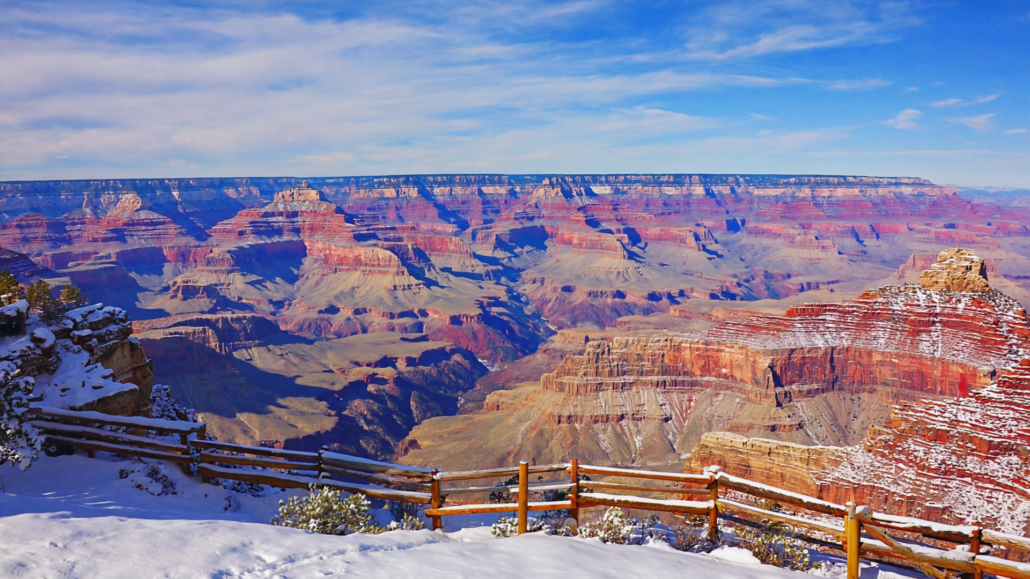
Grand Canyon in Winter: What the South Rim Actually Looks Like When the Crowds Disappear
The ranger at the South Rim entrance gate stamps your pass and waves you through. The parking lot, which in July looks like a Walmart on Black Friday, has maybe a dozen cars scattered across it. You walk to the rim and stop. The canyon is right there, exactly as enormous as you expected, but the world around you is almost completely silent. A thin layer of snow traces the edges of the Kaibab Plateau. The air has that particular winter sharpness that makes everything look cleaner than it should. There is nobody blocking your view. There is no one jostling for the same photograph. The canyon, in this moment, belongs entirely to you.
This is the Grand Canyon winter visit that most people never take. They arrive in summer, stand in lines, peer around tour groups, and leave thinking they’ve experienced it. What they’ve experienced is the crowd. The canyon itself is something else entirely, and winter is one of the few times you can see it without the noise.
This guide breaks down exactly what a Grand Canyon winter visit looks like on the ground: what’s open, what’s closed, what the weather actually does to the experience, and why the best time to visit the Grand Canyon might not be when everyone tells you it is.
Why Winter Changes the Canyon Completely
The Grand Canyon looks different in winter, and not just because of snow. The low-angle winter sun dramatically changes how light moves through the canyon walls. Shadows fall longer and sharper. The red and orange layers of Vishnu Schist, Bright Angel Shale, and Kaibab Limestone catch that golden late-afternoon light at angles that simply don’t exist during midsummer. Photographers who have visited across all four seasons routinely describe winter as the most visually striking period for canyon photography, precisely because of this directional quality of light.
The atmospheric dynamics shift as well. Summer afternoons at the South Rim bring hazy conditions as heat rises from the inner canyon, softening distant views. In winter, that thermal activity is largely absent. Cold, clear air lets you see the details of formations miles away with a clarity that feels almost telescopic. The National Park Service’s climate data for the Grand Canyon confirms that December through February delivers the lowest annual visitor numbers alongside some of the most dramatic visual conditions the canyon produces.
Snow adds an element that no other season can replicate. When a snowstorm moves through, the canyon rims turn white while the inner canyon, which is considerably warmer at lower elevations, often stays dry and red. The contrast between a snow-covered rim and the warm desert tones of the canyon walls creates a scene that feels almost surreal, as though two completely different landscapes have been layered on top of each other. Phantom Ranch, deep in the inner canyon, regularly sees temperatures 20 to 30 degrees warmer than the South Rim during winter storms, which means the geological layers often appear in stark, contrasting clarity from above.
The Crowd Math Nobody Mentions
The South Rim receives roughly five to six million visitors annually. The overwhelming majority of those visits happen between May and October. December, January, and February collectively account for a fraction of that total, meaning the infrastructure, trails, viewpoints, and parking areas designed for peak-season volumes are handling a tiny percentage of that load during winter months. The practical effect is immediate and noticeable. Mather Point, the most visited overlook in the entire National Park system, is walkable without navigating crowds. The Rim Trail, which in summer requires deliberate effort to find a quiet section, becomes a genuinely peaceful walk. Yavapai Point, considered by many photographers to be the finest geological overview on the South Rim, is often entirely empty at dawn in January.
For families, solo travelers, and couples who make the drive expecting the canyon experience they’ve seen in photographs and films, winter removes the single biggest obstacle between them and that experience: other people.
What the Weather Actually Does (Honestly)
Winter weather at the South Rim is the honest complication in this otherwise glowing picture. The rim sits at approximately 7,000 feet in elevation. That elevation matters. Temperatures regularly drop below freezing overnight and often stay in the low 30s to low 40s during the day from December through February. Snow is common, and when it falls, it sticks. Icy patches develop on paved surfaces, including the Rim Trail and the roads through Grand Canyon Village.
What this means practically: you need layers, you need proper footwear, and you need to accept that some days will be genuinely cold. A light jacket that works in Phoenix in December will not work at the canyon rim. The standard guidance from experienced South Rim visitors is to dress as though you’re heading somewhere significantly colder than you expect and to carry waterproof footwear regardless of the forecast, since conditions can change rapidly at this elevation.
Snow Days Are Not Ruined Days
A common concern among first-time winter visitors is that a snowstorm will ruin the trip. The opposite is almost always true. Active snowfall transforms the canyon into something genuinely otherworldly. The usual color palette of reds and tans disappears behind a moving curtain of white, and when the storm breaks, the canyon re-emerges in a completely altered state. Photographers and repeat visitors often describe a mid-winter storm as the single luckiest weather event they’ve encountered at the canyon, specifically because of what the canyon looks like in the hours immediately after snowfall.
The important caveat is road safety. Some interior park roads close temporarily during heavy snow events, and the NPS recommends checking current conditions before traveling. Vehicles without all-wheel drive or winter tires can struggle on icy roads leading to the rim. Checking the NPS Grand Canyon current conditions page before departure is not optional during winter months; it’s basic trip preparation.
The January and February Reality Check
January and February are the coldest months and the quietest. Midday temperatures frequently sit between 35 and 45 degrees Fahrenheit on the rim. Mornings and evenings can drop into the mid-20s. This is genuinely cold outdoor weather, not “chilly” weather. That said, the combination of appropriate clothing, lower humidity (the Southwest in winter is typically dry), and bright sunshine on clear days makes it perfectly comfortable for extended outdoor time. Many visitors are surprised to find themselves warm and comfortable in direct sunlight even when air temperatures are well below 40 degrees.
March begins to moderate and is often considered the best shoulder-season window, sitting at the overlap of low crowds and improving temperatures. Late March can feel almost spring-like on good days, though snow remains possible through April at this elevation.
What’s Open at the South Rim in Winter
The South Rim of Grand Canyon National Park is open year-round, which distinguishes it from the North Rim, which closes typically from mid-November through mid-May due to road conditions and snowpack. This is worth understanding clearly: everything that follows about winter visitation applies to the South Rim only. The North Rim is a completely different conversation during these months.
On the South Rim, the core experience remains fully accessible through winter. The primary viewpoints along the East and West Rim drives are open. The Rim Trail is open. The park’s shuttle bus system operates a reduced schedule but continues to serve the major viewpoints. Most importantly, the inner canyon trails, including the Bright Angel Trail and South Kaibab Trail, remain open (though portions can be icy and require traction devices). Phantom Ranch, accessible by trail, accepts reservations year-round.
Services and Facilities That Operate Year-Round
Several key visitor services remain available through winter months:
- Grand Canyon Village lodging: El Tovar Hotel, Bright Angel Lodge, and Maswik Lodge operate year-round, with some seasonal reduction in available rooms. Yavapai Lodge typically closes in winter.
- Dining: El Tovar Dining Room and Bright Angel Restaurant remain open. Some casual options reduce hours or close seasonally.
- NPS Visitor Center: The official Grand Canyon Visitor Center inside the park at Grand Canyon Village operates year-round, though hours are reduced in winter compared to peak season.
- Ranger programs: A reduced schedule of ranger-led programs continues through winter, including geology talks and guided walks that are often far more intimate than their summer equivalents given the small group sizes.
- Hermit Road: The western scenic drive, which is closed to private vehicles in summer and requires shuttle buses, reopens to private vehicles in winter, giving travelers direct access to some of the finest viewpoints on the South Rim without any shuttle logistics.
The reopening of Hermit Road to private vehicles is one of the most underappreciated advantages of Grand Canyon off season travel. In peak season, reaching Pima Point or Hermits Rest requires either catching the shuttle or cycling. In winter, you drive your own vehicle directly to each overlook and stop as long as you want. For photographers, for families with young children, and for anyone who prefers traveling on their own schedule, this is a significant upgrade to the experience.
What Reduces or Closes in Winter
Transparency matters here. Some services do operate on reduced schedules or close during the off-season:
- Mule rides into the canyon run on a reduced schedule in winter and book out well in advance even then.
- Some concession stands and casual dining options along the rim reduce hours or close between November and March.
- Desert View Watchtower area on the East Rim has reduced services in winter, though the watchtower itself typically remains accessible.
- The Canyon View Information Plaza reduces operating hours outside of summer peak.
None of these reductions materially affect the core canyon experience. The viewpoints, trails, and the canyon itself are all fully available.
Starting Right: The Grand Canyon Visitor Center IMAX in Tusayan
Before you ever reach the park entrance gates, there’s a stop in Tusayan that changes how you see everything that follows. Grand Canyon Visitor Center IMAX, located in Tusayan just outside the South Rim entrance, operates year-round and serves as the most practical orientation point for any South Rim trip, including winter visits when road conditions and park logistics benefit from advance preparation.
The centerpiece is the Grand Canyon IMAX Theater, screening “Grand Canyon: Rivers of Time” on a six-story screen using IMAX with Laser technology. The film covers the geological history of the canyon, its cultural significance, and the living ecosystems within it in a way that no trail map or brochure can replicate. Watching it before entering the park gives you a framework for what you’re about to see, and in winter, when light conditions and snow coverage can dramatically alter how the canyon looks, that geological context makes the visual experience considerably richer.
In winter specifically, this stop carries additional practical value. The facility sells various National Park entrance passes on-site, which means you can handle that transaction in a warm, comfortable building before pulling up to the park gate. If you’re arriving with a vehicle full of family members who’ve been driving for hours, that’s not a minor convenience. The on-site dining at Pizza Hut Express and Explorers Café gives everyone a chance to eat and regroup before heading into the park. The large retail store carries hiking gear and warm-weather layers, which matters considerably if someone in your group underestimated how cold 7,000 feet in January actually feels. For EV drivers, the facility offers Ultra-Fast 150 kW and Hyper-Fast 350 kW charging stations on-site, making it a logical pre-park stop for road trippers coming through Tusayan.
Pink Jeep Tours operates its office on-site, with guided tours departing from the front door. Every Pink Jeep Tour originating from Grand Canyon Visitor Center IMAX includes a “Rivers of Time” IMAX ticket, creating a natural pairing of cinematic orientation and hands-on canyon exploration. In winter, Pink Jeep’s guided tours offer a particular advantage: a knowledgeable guide who understands current trail and road conditions, wildlife patterns, and the best seasonal viewpoints. Rather than navigating icy roads and guessing which overlooks are accessible on a given day, you’re traveling with someone who knows. For first-time visitors making a winter trip, that’s a meaningful difference. You can use the Tusayan shuttle and pre-park logistics guide to plan your arrival sequence efficiently.
Book IMAX online and save on tickets, making this stop an efficient and affordable first chapter of any Grand Canyon winter trip.
The Best Viewpoints for a Winter Grand Canyon Experience
Not all viewpoints deliver equally in winter. The combination of low-angle light, snow coverage, and reduced crowds creates some specific standout locations that reward winter visitors who know where to go.
Mather Point at Dawn
In summer, Mather Point at sunrise means competition for space with dozens of other photographers and visitors. In winter, you may have it entirely to yourself. The east-facing aspect of this viewpoint means the first light of the day hits the canyon walls directly, creating a progression of color from deep shadow to bright gold that unfolds over 20 to 30 minutes. When snow covers the rim around you, the thermal difference between the cold rim and the warmer canyon below often generates thin mist rising from the inner gorge, adding an atmospheric quality to the scene that summer visitors simply never see.
Yavapai Geology Museum and Point
Yavapai Point is where serious understanding of canyon geology begins. The geology museum here, operated by the NPS, provides context for the canyon’s formation in a way that’s accessible to non-scientists. In winter, the combination of clear air and the museum’s panoramic windows creates an ideal setting for understanding what you’re looking at. The point itself faces slightly west, making it excellent for afternoon light in winter when the sun sits lower and illuminates the canyon’s depth rather than washing it out.
Lipan Point and the East Rim Drive
Lipan Point, accessible via the East Rim Drive, offers one of the longest and most geologically varied views on the South Rim. The Colorado River is visible from here, curving through the inner gorge in a way that gives you a genuine sense of the canyon’s scale. In winter, this drive is quiet, uncrowded, and often strikingly beautiful if there’s snow on the rim. Desert View Watchtower, at the eastern end of the drive, provides a 360-degree perspective that includes views toward the Painted Desert and Navajo lands to the east, an orientation that feels genuinely expansive on a clear winter day.
Hermit Road Viewpoints (Winter Exclusive Access)
As noted earlier, Hermit Road reopens to private vehicles in winter. This makes viewpoints like Pima Point, Mohave Point, and Powell Point directly accessible without shuttle logistics. Pima Point in particular offers a spectacular view of the Colorado River and the Granite Gorge below, and on clear winter days, the river is visible as a thin silver thread nearly a mile below. The drive itself, with pinyon pine and juniper forest lining both sides, is genuinely scenic and far more peaceful in winter than during the summer shuttle-bus season.
Winter Hiking: What the Trails Actually Offer
Hiking in winter at the Grand Canyon requires honest preparation, but it is entirely feasible and deeply rewarding for those who come equipped. The critical difference from summer hiking is not the distance or the difficulty; it’s the surface conditions.
The Rim Trail in Winter
The paved Rim Trail, stretching roughly 13 miles along the South Rim, is the most accessible winter walking option. Paved sections are manageable with regular footwear on dry days, though icy patches develop overnight and in shaded sections that don’t see direct sun. The trail offers continuous canyon views and connects all the major viewpoints, making it possible to walk for an hour or four hours depending on your group’s preference. In winter, the near-absence of crowds on this trail makes the experience feel more like a private discovery than a tourist attraction.
Bright Angel Trail: The First Mile Is Different in Winter
The Bright Angel Trail’s upper sections, from the trailhead down to the 1.5-mile resthouse, are frequently icy in winter and require traction devices. Microspikes or Yaktrax are strongly recommended and often available for purchase at the gear retail store at Grand Canyon Visitor Center IMAX in Tusayan before you enter the park. Below the ice zone, the trail typically opens to dry, accessible conditions as you descend into the warmer inner canyon elevations. Day hikers who descend to Indian Garden (now renamed Havasupai Gardens) in winter often find it a dramatically different experience from summer: cool, quiet, and free of the dehydration risk that makes summer inner-canyon hiking genuinely dangerous.
South Kaibab Trail: Views Without the Forest
The South Kaibab Trail offers the most exposed, panoramic hiking on the South Rim, traveling along ridge spines rather than descending through side canyons. This means no shade and no water, but in winter, neither of those is a pressing concern. The upper sections of the South Kaibab Trail to Ooh Aah Point (approximately 1.8 miles round trip) deliver some of the finest panoramic views available anywhere on the South Rim with a very modest elevation change. Snow coverage on this trail creates a genuinely dramatic visual experience, with the red canyon walls dropping away below a white ridge walk. The trail can be icy at the top and requires traction devices after snowfall.
Grand Canyon Shoulder Season Tips for the Best Off-Peak Windows
If winter’s coldest months feel like too much of a commitment, the shoulder seasons on either side deliver a compelling middle ground. Understanding the nuances of these windows is where Grand Canyon shoulder season tips become genuinely useful.
November: The Golden Window
November is arguably the most underappreciated month on the South Rim. Crowds drop sharply after the first week of November as summer and fall visitors wrap up their travel seasons. Temperatures are cool but manageable, typically ranging from the mid-40s to low 60s during the day at the rim. Snow is possible but not typical in early November. The cottonwood trees along the canyon’s lower reaches and Bright Angel Creek often hold their fall color into early November, adding warm yellows and golds to the canyon’s color palette. The combination of autumn color, crowd reduction, and comfortable temperatures makes November one of the most pleasant months for a South Rim visit.
March: The Shoulder Season Comeback
March brings the beginning of the transition back toward spring. Temperatures begin to moderate, though snowfall is still possible. The key advantage of March is that it sits before spring break crowds arrive in earnest. Early March can feel very similar to January in terms of visitor volumes, while late March begins to see an uptick as school breaks approach. For travelers with flexibility, the first two weeks of March represent a genuine sweet spot: improving weather, still-manageable crowds, and the first signs of spring vegetation beginning to emerge in the inner canyon.
The Comparison That Matters
| Month | Avg. Daytime Temp (Rim) | Crowd Level | Snow Risk | Hermit Road Access | Best For |
|---|---|---|---|---|---|
| November | 45–60°F | Low ✅ | Low ⚠️ | Private vehicles ✅ | Hiking, photography, fall color |
| December | 35–45°F | Very Low ✅ | Moderate ⚠️ | Private vehicles ✅ | Snow photography, solitude |
| January | 32–42°F | Lowest ✅ | High ⚠️ | Private vehicles ✅ | Maximum solitude, dramatic conditions |
| February | 34–45°F | Very Low ✅ | Moderate–High ⚠️ | Private vehicles ✅ | Photography, uncrowded hiking |
| March | 42–58°F | Low–Moderate ⚠️ | Low ⚠️ | Private vehicles ✅ | Shoulder season balance, families |
| July (reference) | 75–85°F | Peak ❌ | None ✅ | Shuttle only ❌ | Crowds, heat, logistics challenges |
Planning a Winter Trip: Practical Logistics That Actually Matter
The logistics of a winter Grand Canyon visit differ enough from summer that treating them as identical will create friction. The following planning considerations are based on the specific realities of off-season South Rim travel.
Accommodation Strategy
Lodging inside the park at Grand Canyon Village is considerably easier to book in winter than in summer, when reservations for the most popular properties sometimes sell out six months in advance. In winter, last-minute bookings are often possible, though not guaranteed for the most desirable properties like El Tovar. Tusayan, the gateway town just outside the South Rim entrance, offers a range of accommodation options that remain operational year-round and provide the added convenience of being right next to Grand Canyon Visitor Center IMAX for early-morning or late-evening logistics.
Getting There in Winter
The primary access road to the South Rim is Arizona State Route 64, which remains open year-round. The road from Williams, Arizona to the South Rim entrance is a two-lane highway that can become snow-covered during winter storms. If you’re driving from Flagstaff or Williams in winter conditions, all-wheel drive or snow tires are strongly recommended. Check road conditions through Arizona 511 road conditions before departing.
Flagstaff, 80 miles to the south, serves as the most practical base for winter visitors arriving by air. Phoenix Sky Harbor is approximately four hours by car and is the most common arrival point for visitors flying in from outside the Southwest. Both options are viable; Flagstaff simply eliminates a significant portion of winter driving distance.
What to Pack for a Winter Rim Visit
The layering principle applies strongly here. The canyon rim can swing from 25 degrees at dawn to 50 degrees by midday on a clear winter day. Clothing that can be added and removed efficiently is far more useful than a single heavy coat. Key items for a winter South Rim visit include:
- Waterproof outer layer: Wind and snow can arrive quickly at this elevation without much warning.
- Insulating mid-layer: Down or synthetic insulation for standing at viewpoints when you’re not generating body heat from walking.
- Waterproof, insulated footwear: Waterproof hiking boots with some insulation are the standard recommendation. Running shoes are inadequate in wet or snowy conditions.
- Traction devices: Microspikes or Yaktrax for any inner canyon trail hiking. These are lightweight and worth carrying even if you end up not needing them.
- Sun protection: Winter sun at 7,000 feet is more intense than it feels. UV exposure combined with snow reflection makes sunburn a real risk even in cold temperatures.
- Hydration: Cold air and dry Southwest conditions create dehydration risk that feels less urgent than in summer but is equally real.
If you find yourself in Tusayan and realize you’re underprepared, the retail store at Grand Canyon Visitor Center IMAX carries hiking gear and warm-weather layers, making it a practical last stop before entering the park.
National Park Pass Considerations
Entry to Grand Canyon National Park requires a valid pass. The standard vehicle pass covers the entry fee for a set number of days. The America the Beautiful Annual Pass, which covers entry to all National Park Service sites for 12 months, offers strong value for anyone planning multiple park visits during a road trip through the Southwest. Both options are available for purchase at Grand Canyon Visitor Center IMAX in Tusayan before you reach the park gate, which eliminates the need to handle that transaction at the entrance station, particularly useful on days when the gate area is handling multiple vehicles simultaneously.
Wildlife in Winter: What You’re More Likely to See
The Grand Canyon’s wildlife is not absent in winter; it’s simply behaving differently. Several species are actually more visible during the off-season months, which adds a dimension to winter visits that summer crowds often miss entirely.
California condors, among the most dramatic birds in North America and one of the great conservation success stories of the modern era, are year-round residents at the Grand Canyon. Condors frequently soar near the rim viewpoints, and in winter’s clear air they’re often visible from considerable distances. With a wingspan reaching nearly ten feet, they’re unmistakable when they pass close to viewpoints along the rim. For tips on what to watch for and responsible viewing distances, the Grand Canyon wildlife viewing guide covers the specific behaviors and locations where wildlife sightings are most common.
Mule deer are frequently seen in Grand Canyon Village and along the Rim Trail in winter, often browsing vegetation with considerably less caution than they’d show in peak season when the area is crowded with people. Ravens, year-round residents, are highly active in winter and famously intelligent. Watching a raven work the updrafts rising from the canyon on a cold, clear morning is one of those small-scale canyon experiences that doesn’t make the highlight reels but stays with you.
Elk are present in the Kaibab Plateau forests surrounding the South Rim and are more frequently spotted near roads and in meadow clearings during winter months when their movements are less concealed by summer foliage.
The Grand Canyon South Rim Visitor Center and Winter Orientation
The official Grand Canyon South Rim Visitor Center, operated by the National Park Service inside the park at Grand Canyon Village, operates year-round with reduced winter hours. It serves as the NPS information hub inside the park, offering maps, ranger assistance, backcountry permits (for overnight inner-canyon hiking), and interpretive exhibits on canyon geology and ecology. In winter, staffing levels are lower than peak season, but the core services remain available.
For visitors arriving from outside the park, Grand Canyon Visitor Center IMAX in Tusayan provides complementary orientation services before park entry. The IMAX film “Grand Canyon: Rivers of Time” delivers the geological and cultural context that helps visitors understand what they’re seeing once they reach the rim, functioning as a visual and educational foundation for the park experience. This is distinct from the NPS Visitor Center inside the park and serves a different purpose: cinematic immersion and trip orientation before the park gates, rather than ranger services and permit processing inside the park. Both are valuable; they serve different parts of the visitor experience.
For first-time visitors, the sequence that most consistently produces a satisfying trip is: start at Grand Canyon Visitor Center IMAX in Tusayan for IMAX, dining, pass purchase, and gear check, then proceed to the park entrance and the NPS Visitor Center at Grand Canyon Village for maps and current trail conditions, then follow the rim trail and viewpoints from there. In winter, this sequence takes on added value because the IMAX film’s geological context is particularly useful when snow coverage and low light create a different visual landscape than the one most visitors have seen in photographs.
Frequently Asked Questions About Winter Grand Canyon Visits
Is the Grand Canyon worth visiting in winter?
Unambiguously yes. The combination of dramatically reduced crowds, unique snow-covered visuals, superior air clarity, and the private-vehicle access to Hermit Road makes winter one of the most rewarding times to visit the South Rim. The trade-off is cold temperatures that require preparation, but that preparation is straightforward.
Does it snow at the Grand Canyon South Rim?
Yes. The South Rim sits at approximately 7,000 feet elevation, and snowfall is common from December through March. Significant snowfall can occur in November and April as well. Snow typically melts from paved areas within a day or two on clear days, but shaded areas and trails can hold ice for longer periods.
What should I wear to the Grand Canyon in winter?
Layer strategically. A waterproof outer shell, an insulating mid-layer (down or synthetic), a base layer, warm hat and gloves, and waterproof insulated footwear are the essentials. Traction devices like microspikes are recommended if you plan to hike any inner canyon trails. Sun protection is necessary even in cold weather at this elevation.
Are the trails open at the Grand Canyon in winter?
Most trails remain open in winter, including the Bright Angel Trail and South Kaibab Trail. Upper sections of inner canyon trails can be icy after snowfall and require traction devices. The Rim Trail is generally accessible with appropriate footwear. Check current conditions at the NPS website before hiking.
Can I drive Hermit Road in winter?
Yes. Hermit Road is closed to private vehicles from March through November and requires shuttle buses during that period. In winter, private vehicles have full access to all viewpoints along this road, which is one of the most significant practical advantages of visiting during the off-season.
Is the North Rim open in winter?
No. The North Rim closes typically in mid-November and reopens in mid-May due to deep snowpack and road conditions. All winter visitation at the Grand Canyon occurs at the South Rim.
What is Grand Canyon Visitor Center IMAX and where is it?
Grand Canyon Visitor Center IMAX is a privately operated visitor center located in Tusayan, Arizona, just outside the South Rim entrance gates. It is not affiliated with the National Park Service and is separate from the official NPS Visitor Center inside Grand Canyon Village. The facility houses the Grand Canyon IMAX Theater screening “Grand Canyon: Rivers of Time,” on-site dining at Pizza Hut Express and Explorers Café, a large retail store, Pink Jeep Tours, National Park pass sales, and EV charging stations.
How far is Tusayan from the South Rim entrance?
Tusayan is approximately one mile from the South Rim entrance gate. Grand Canyon Visitor Center IMAX is the first major facility visitors encounter coming from the south on AZ-64, making it a natural first stop before entering the park.
Is it safe to drive to the Grand Canyon in winter?
It is safe with appropriate preparation. The primary access road (AZ-64) is maintained year-round. During and after significant snowstorms, all-wheel drive or snow tires are strongly recommended. Check Arizona 511 road conditions before departing in winter. Road closures inside the park are rare but possible during major snow events.
What is the best time to visit the Grand Canyon for fewest crowds?
January and February consistently see the lowest visitor volumes of any months in the year. December and November are also significantly quieter than any summer or spring month. If avoiding crowds is the primary goal, any visit between mid-November and the end of February will deliver a materially different, more spacious experience than a peak-season visit.
Can I do Pink Jeep Tours in winter?
Yes. Pink Jeep Tours operates from Grand Canyon Visitor Center IMAX in Tusayan year-round. Winter tours offer a distinct experience with smaller groups and the possibility of snow-covered landscape views. Every Pink Jeep Tour departing from Grand Canyon Visitor Center IMAX includes a ticket to the “Grand Canyon: Rivers of Time” IMAX film.
Do I need a National Park pass to enter the Grand Canyon?
Yes. A valid National Park entrance pass is required to enter Grand Canyon National Park. Options include a single-visit vehicle pass and the America the Beautiful Annual Pass. Both can be purchased at Grand Canyon Visitor Center IMAX in Tusayan before reaching the park entrance gate.
Key Takeaways
- The South Rim is open year-round, making a Grand Canyon winter visit fully feasible and, for many travelers, preferable to peak season.
- Winter crowds are a fraction of summer volumes, transforming the experience at viewpoints, trails, and along the Rim Trail from crowded to genuinely spacious.
- Hermit Road opens to private vehicles in winter, giving direct access to some of the finest viewpoints on the South Rim without shuttle logistics.
- Snow enhances rather than ruins the experience for prepared visitors. The visual contrast of white rim against red canyon walls is one of the most striking things the South Rim produces.
- Cold temperatures require preparation: waterproof layers, insulated footwear, traction devices for icy trails, and sun protection are all essential winter kit.
- Grand Canyon Visitor Center IMAX in Tusayan is a practical year-round first stop for IMAX orientation, National Park pass purchases, dining, gear, and Pink Jeep tour bookings before entering the park.
- November and March offer shoulder-season balance: lower crowds without the most challenging cold conditions, making them ideal for families or first-time visitors not ready for full winter conditions.
- Wildlife viewing improves in winter, with condors, mule deer, elk, and ravens all regularly visible around the rim and in the surrounding forest.
- The IMAX film “Grand Canyon: Rivers of Time” is especially valuable for winter visitors, providing geological context that enriches what you see when snow coverage and unusual light conditions change the canyon’s familiar appearance.
The canyon does not get smaller in winter. It does not become less geological, less dramatic, or less worth making the trip. What winter removes is the layer of summer logistics that sits between you and it. The crowds, the shuttle queues, the competition for parking, the noise at the overlooks, the heat-related trail restrictions, all of it recedes. What’s left is the canyon itself, in the clearest air of the year, with snow on the rim and silence at the viewpoints. Start your Grand Canyon adventure with IMAX at Grand Canyon Visitor Center IMAX in Tusayan, pick up your park pass, and drive through the gate. The South Rim in winter is waiting to be seen.

About the author
Explore The Canyon Editorial Team
See The Canyon

